The Molecular Structure Behind Everyday Water
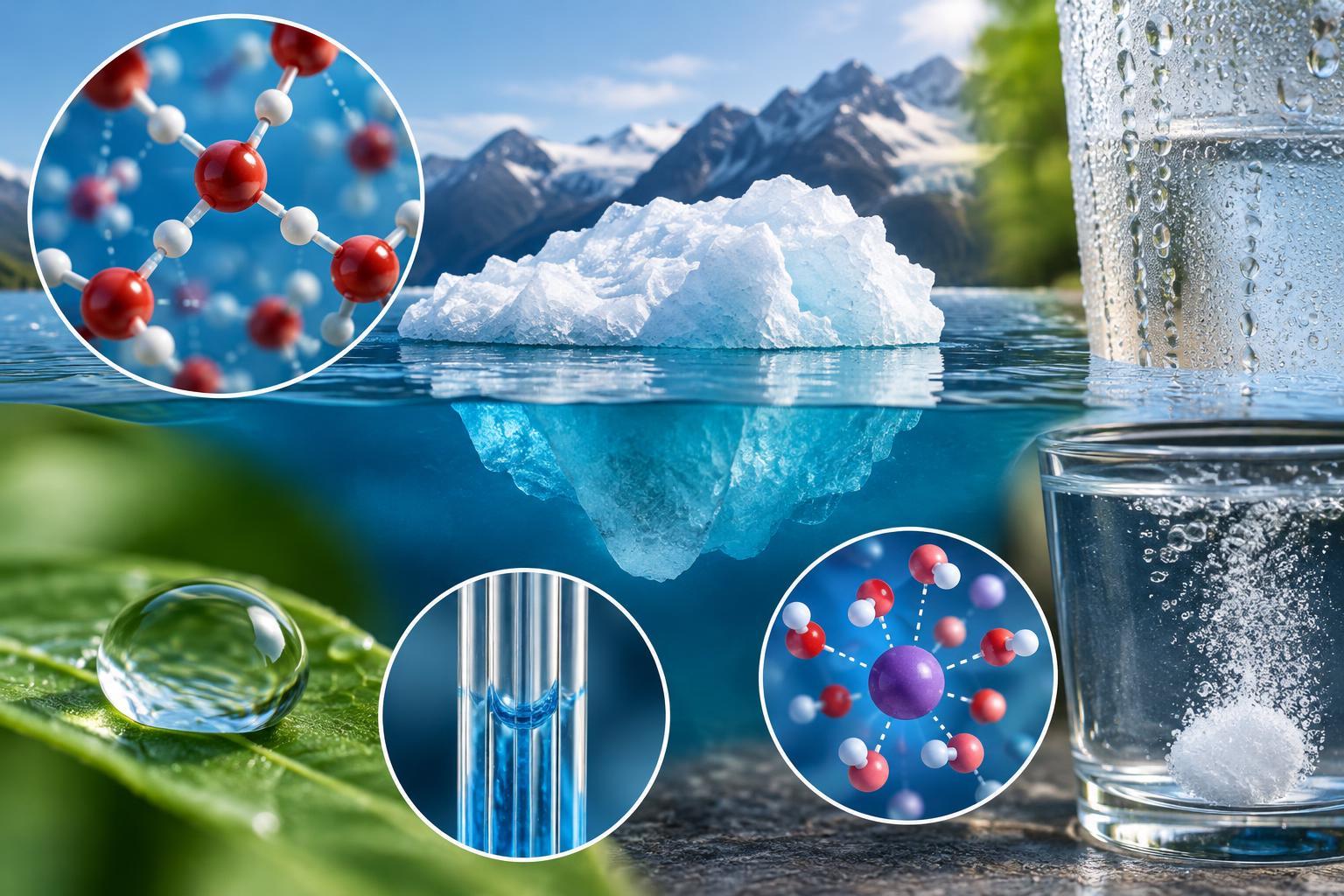
A floating ice cube, a bead of rain on a leaf, and a lake that stays cool after the air warms might seem unrelated. Each reflects properties of water that begin at the molecular scale. The central connection is hydrogen bonding: an attraction between molecules that influences how water arranges itself and responds to energy.
A water molecule contains one oxygen atom bonded to two hydrogen atoms in a bent shape. Oxygen attracts the shared electrons more strongly than hydrogen does, creating an uneven distribution of electrical charge. The oxygen side is partially negative, while the hydrogen sides are partially positive. This makes water a polar molecule, even though its overall electrical charge is zero.
The partially positive hydrogen of one molecule can attract the oxygen of another, forming a hydrogen bond. These attractions are weaker than the covalent bonds holding each molecule together, but collectively they matter enormously. In liquid water, they form a shifting network: molecules move, connections break, and new connections form. Water is therefore neither a collection of independent particles nor a rigid molecular framework.
Why Ice Floats and Water Expands When It Freezes
Most substances become denser when they solidify, but ordinary ice is less dense than liquid water. As water freezes under everyday pressure conditions, hydrogen bonds organize its molecules into an open crystal structure. That arrangement occupies more space than the same number of molecules typically occupy in the liquid, so freezing increases volume.
Liquid water has no permanent crystal lattice. Some molecules can occupy spaces that remain open in ice, allowing a closer average packing. Pure liquid water reaches its maximum density near 4 degrees Celsius at ordinary atmospheric pressure. Cooling it further toward freezing increasingly favors more open local arrangements, and its density decreases.
These properties help explain why freshwater lakes often freeze at the surface while liquid water remains below. Floating ice also slows heat transfer between the water and cold air, especially when covered by snow. The outcome depends on lake depth, weather, mixing, and dissolved substances; it does not mean every body of water follows an identical freezing pattern. Expansion during freezing also explains why tightly filled containers can crack.
Why Water Stores Heat and Evaporation Removes It
Water has a relatively high specific heat capacity: raising the temperature of a given mass requires substantial energy compared with many common materials. Its molecular interactions, including the hydrogen-bond network, contribute to this behavior. Added energy changes both molecular motion and the arrangements and interactions among molecules, so temperature does not rise as quickly as it does in many other substances.
This makes water useful for transporting and buffering heat. A pot of water warms gradually, and large bodies of water can moderate nearby temperature swings. Oceans influence climate partly through heat storage, although circulation, winds, and exchanges with the atmosphere are also essential. Heat capacity alone cannot explain a region’s climate.
Evaporation provides a different cooling mechanism. Molecules escaping from liquid into vapor must overcome attractions to neighboring molecules, and this transition requires energy. When that energy comes from the liquid and its surroundings, they cool. Evaporation can occur below the boiling point because some molecules at the surface have sufficient energy to escape. Humidity, airflow, temperature, and exposed surface area all affect the rate.
Why Droplets Form and Water Climbs Narrow Spaces
Water’s surface behaves differently from its interior because molecules at the boundary have a different balance of neighboring interactions. Creating additional surface area requires energy. This produces surface tension, which favors shapes with less exposed area. Small, freely suspended droplets tend toward spheres because a sphere has the smallest surface area for a given volume.
A droplet resting on a material also responds to adhesion: attraction between water and that surface. Strong adhesion encourages spreading, while weaker adhesion favors beading. In narrow, wettable tubes or pores, adhesion and surface tension can draw water upward against gravity. This capillary action helps explain how paper towels absorb spills. It contributes to water movement in plants too, but transpiration-driven tension is central to lifting water through tall trees.
Why Water Dissolves Some Materials but Not Others
Water’s polarity also helps it dissolve many ionic and polar substances. Around dissolved salt ions, water molecules orient their partially charged regions toward the ions, helping stabilize them in solution. Whether a substance dissolves readily depends on the overall balance of interactions and entropy, not simply on whether water can attract it.
Nonpolar substances, including many oils, interact less favorably with water and often separate into distinct phases. Water is therefore a versatile solvent, not a universal one. Across all these examples, the useful starting point is the same: molecular structure shapes interactions, and those interactions produce large-scale behavior. Hydrogen bonding connects many of water’s unusual properties, while temperature, pressure, dissolved materials, and surrounding surfaces determine how those properties appear in practice.