What actually breaks an object?
A fragile object can break when a force bends, compresses, or stretches part of it beyond what the material can tolerate. The important event is often not the movement itself but a sudden change in movement. A glass that slides across a box and stops against a hard wall, for example, may experience a sharper impact than a glass that stays in place through the same journey.
The shape of an object matters as much as its material. A broad, flat surface can spread a load, while a thin rim or projecting handle concentrates it in a small area. This helps explain why a sturdy-looking mug might survive pressure on its base but lose its handle after a modest knock. Packing should therefore protect vulnerable features, not merely cover the object’s largest surfaces.
Why cushioning helps—and when it does not
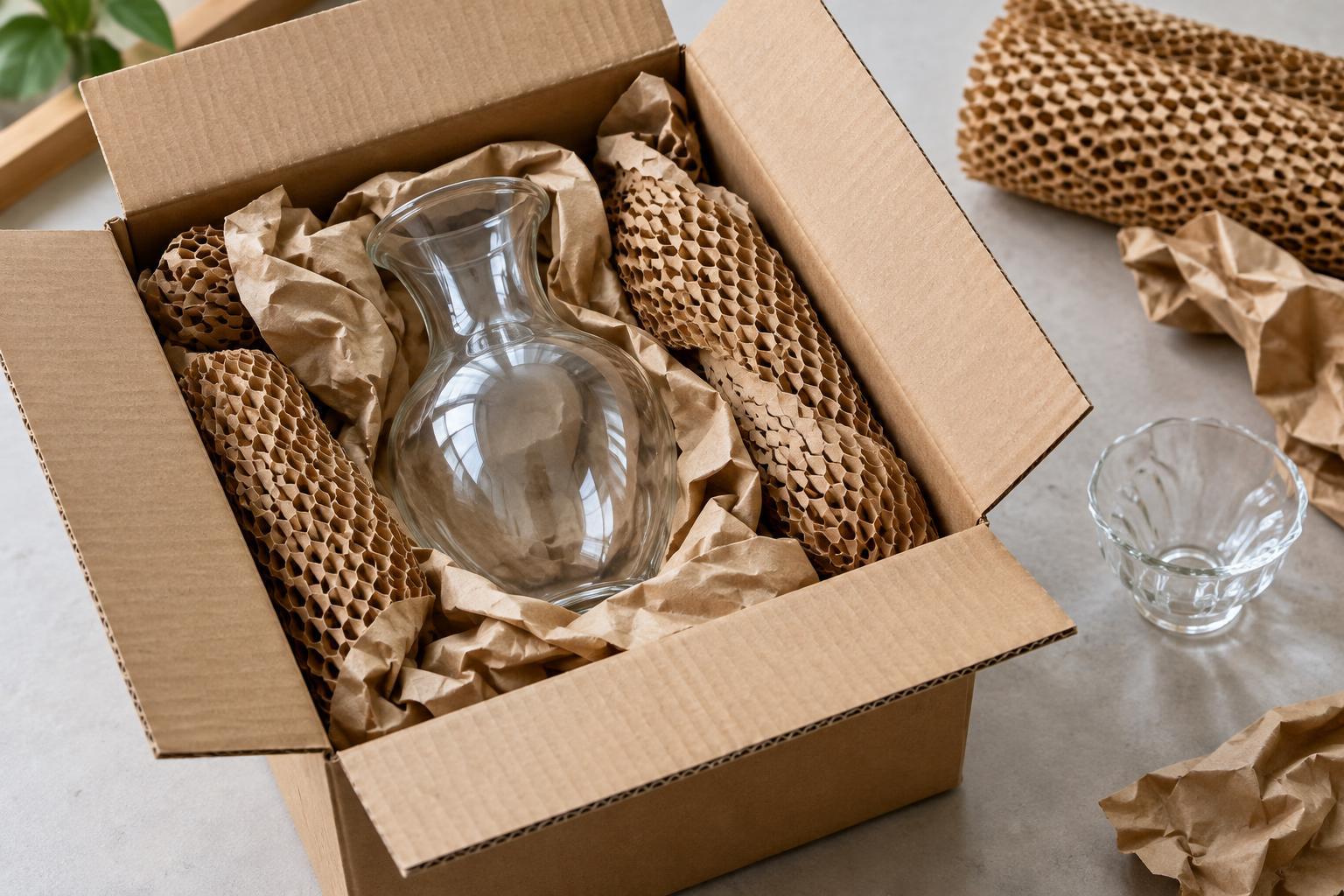
Cushioning works in part by giving a moving object more distance and time to come to a stop. Instead of striking a rigid box wall abruptly, the object presses into material that slows it more gradually. Cushioning can also spread pressure over a wider area. Both effects depend on how the material behaves under load: a layer compressed completely flat has little room left to soften another impact.
More padding is not automatically better. Loose material may settle, leaving a gap that lets an item gain speed before it hits something. Tightly packed material may leave too little room to deform. The goal is a stable fit with enough resilient material around the item to limit movement and soften contact. Pay particular attention to the bottom of a box, which may receive a direct jolt when the box is set down.
For further browsing on practical ways to wrap and secure items, explore Pakowanie i zabezpieczenia · Przeprowadzka z Planem. Different objects call for different arrangements, but the same principle applies: protect weak points and prevent hard surfaces from meeting.
Inside the box: collisions, weight, and stacking
Items packed together can become hazards to one another. If two hard objects share a box without a divider, a bump may drive them into direct contact even if the outer box remains undamaged. Separating them and filling gaps reduces that risk. A useful check is to close the box gently and move it a short distance: noticeable shifting suggests that the contents need more support.
Weight distribution matters too. A heavy item placed above a delicate one can press on it while the box is carried or stacked. Put heavier objects low, and avoid relying on a fragile object to support the weight of other contents. Fill empty space above items so they cannot jump upward and land awkwardly, but do not force the lid closed against them.
The route a box takes also affects its contents. Carrying, loading, vehicle vibration, unloading, and stacking each create different demands. For more ideas about planning those stages, browse Transport i organizacja · Przeprowadzka z Planem. Packing cannot eliminate every jolt, but anticipating where a box will be lifted or placed helps you decide how much support it needs.
A simple way to test your packing
You can inspect a packed box without subjecting it to a dramatic drop. Before sealing it, check that vulnerable edges and handles are separated from the box walls and neighboring objects. After closing it, lift it as you expect it to be lifted during transport. If the shape bows noticeably, the container may be overloaded or insufficiently supported. If you hear or feel contents shifting during gentle movement, reopen the box and adjust the fit.
Labeling a box as fragile can alert a handler, but the label does not change the forces inside it. A well-packed box should not depend on everyone keeping it perfectly upright or setting it down without a bump. Once it reaches its destination, unpack heavy items carefully rather than pulling out cushioning in a way that lets delicate pieces fall. For further browsing about organizing that next stage, visit Nowe miejsce na start · Przeprowadzka z Planem.
The practical principle
Protecting a fragile object is less about adding the thickest possible wrapper and more about controlling its surroundings. Keep it from moving freely, give cushioning room to deform, separate it from hard neighbors, and avoid placing loads on its weakest features. These choices apply beyond moving boxes—to stored equipment, shipped samples, or anything carried in a case. Thinking about how an item might accelerate, stop, and bear weight makes packing decisions easier to explain and easier to improve.