1. Carbon Reservoirs: Where Carbon Is Stored
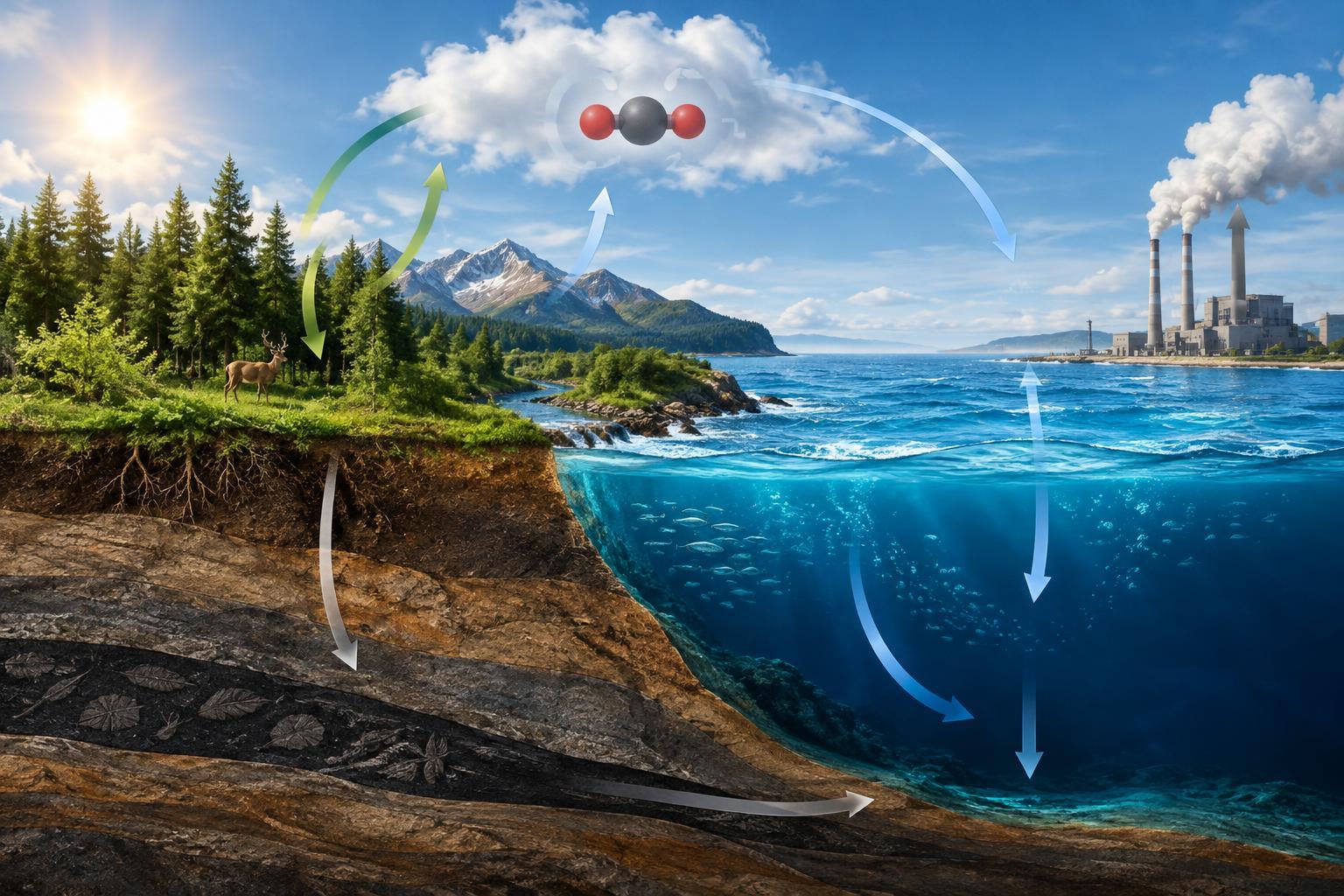
Carbon is an essential component of life and a major part of Earth's chemistry. The carbon cycle describes its movement among reservoirs: places where carbon is stored for varying lengths of time. These include the atmosphere, oceans, vegetation, soils, sediments, and rocks. Carbon does not disappear when it leaves one reservoir; it moves elsewhere, often changing chemical form along the way.
In the atmosphere, carbon occurs mainly as carbon dioxide, with smaller amounts in gases such as methane. Living organisms hold carbon in sugars, fats, proteins, and other molecules. Soils contain carbon in roots, dead organic material, microbes, and mineral-associated forms. Oceans store much of their carbon as dissolved bicarbonate, alongside carbonate ions, dissolved carbon dioxide, and organic material.
Rocks and sediments form the largest long-term reservoirs, but reservoir size is not the same as influence over short-term change. Much geological carbon is exchanged very slowly. By contrast, a relatively small addition to atmospheric carbon dioxide can affect Earth's energy balance. To understand the cycle, we therefore need to track both stocks, meaning stored amounts, and fluxes, meaning rates of transfer.
2. The Fast Cycle: Photosynthesis, Respiration, and Decay
Photosynthesis draws carbon dioxide from the atmosphere into plants and, in aquatic environments, into algae and other photosynthetic organisms. Using light energy, these organisms turn inorganic carbon into organic compounds. That carbon then moves through food webs as organisms eat plants, prey, or dead material. Some remains in living biomass; some passes into soil or sediments.
Respiration moves carbon in the opposite direction. Plants, animals, and microbes break down organic compounds to obtain energy, releasing carbon dioxide. Decomposition also returns carbon to the environment. Where oxygen is scarce, such as in waterlogged soils, microbial processes can produce methane. Fires release stored carbon rapidly, while also leaving behind some carbon in charcoal and other residues.
These exchanges are called the fast carbon cycle, although their timescales range from days to centuries. Seasonal plant growth and decay create a recurring atmospheric carbon dioxide pattern, especially across the Northern Hemisphere. Crucially, carbon uptake is not automatically permanent storage. A growing forest can accumulate carbon, but its long-term balance depends on respiration, decomposition, disturbance, harvesting, and what happens to the land afterward.
3. Oceans and Rocks Connect Short and Long Timescales
The ocean exchanges carbon dioxide with the atmosphere across its surface. The direction and rate depend on differences in carbon dioxide levels, water temperature, winds, and seawater chemistry. Colder water generally dissolves more carbon dioxide than warmer water. Ocean circulation transports carbon into deeper waters, where it may remain isolated from the atmosphere for centuries or longer.
Marine organisms also move carbon downward. Photosynthetic plankton take up dissolved carbon, and some of that carbon sinks in dead organisms, waste, and other particles. Most is recycled before reaching the seafloor. A smaller portion enters sediments. Shell-building organisms contribute another pathway by forming calcium carbonate, although the chemistry of shell formation means it is not simply equivalent to removing atmospheric carbon dioxide.
Over geological timescales, chemical weathering, sediment burial, and tectonic processes connect the surface cycle with Earth's interior. Weathering of silicate rocks can consume carbon dioxide, with carbon eventually stored in marine carbonate sediments. Heat and geological activity can later return carbon dioxide through volcanic and metamorphic processes. This slow cycle helps regulate climate over long periods, but it cannot quickly offset today's fossil fuel emissions.
4. How Human Activities Change the Balance
Burning coal, oil, and natural gas transfers carbon from geological storage into the atmosphere on a much shorter timescale than it accumulated. Cement production also releases carbon dioxide when limestone is chemically transformed. These activities add carbon to the active atmosphere-ocean-land system, rather than merely circulating carbon already moving through recent plant growth and decay.
Land-use changes alter the balance as well. Clearing forests can release carbon from vegetation and soils while reducing future uptake. Draining peatlands exposes carbon-rich material to decomposition. Regrowth and ecosystem restoration can rebuild some stores, but the amount and durability depend on local conditions and subsequent management.
Natural carbon exchanges are large, but their size does not make human emissions insignificant. The key is the net balance: if total inputs exceed total removals, atmospheric carbon increases. Land ecosystems and oceans absorb part of the added carbon, slowing atmospheric accumulation without eliminating it. Higher carbon dioxide concentrations warm the climate, while ocean uptake changes seawater chemistry and causes acidification.
5. What the Carbon Cycle Means for Climate Solutions
A useful way to assess any carbon-related proposal is to ask three questions: Which reservoir gains carbon? Which reservoir loses it? How long is the transfer likely to last? Protecting a forest, restoring a peatland, and storing captured carbon underground involve different pathways, timescales, and risks of reversal.
Reducing fossil fuel emissions limits new transfers from long-term storage into the active cycle. Protecting ecosystems helps preserve existing stocks, while additional carbon removal may address some accumulated emissions. These approaches can complement one another, but they are not interchangeable. Carbon accounting must distinguish avoided emissions from removals and consider how securely carbon remains stored.