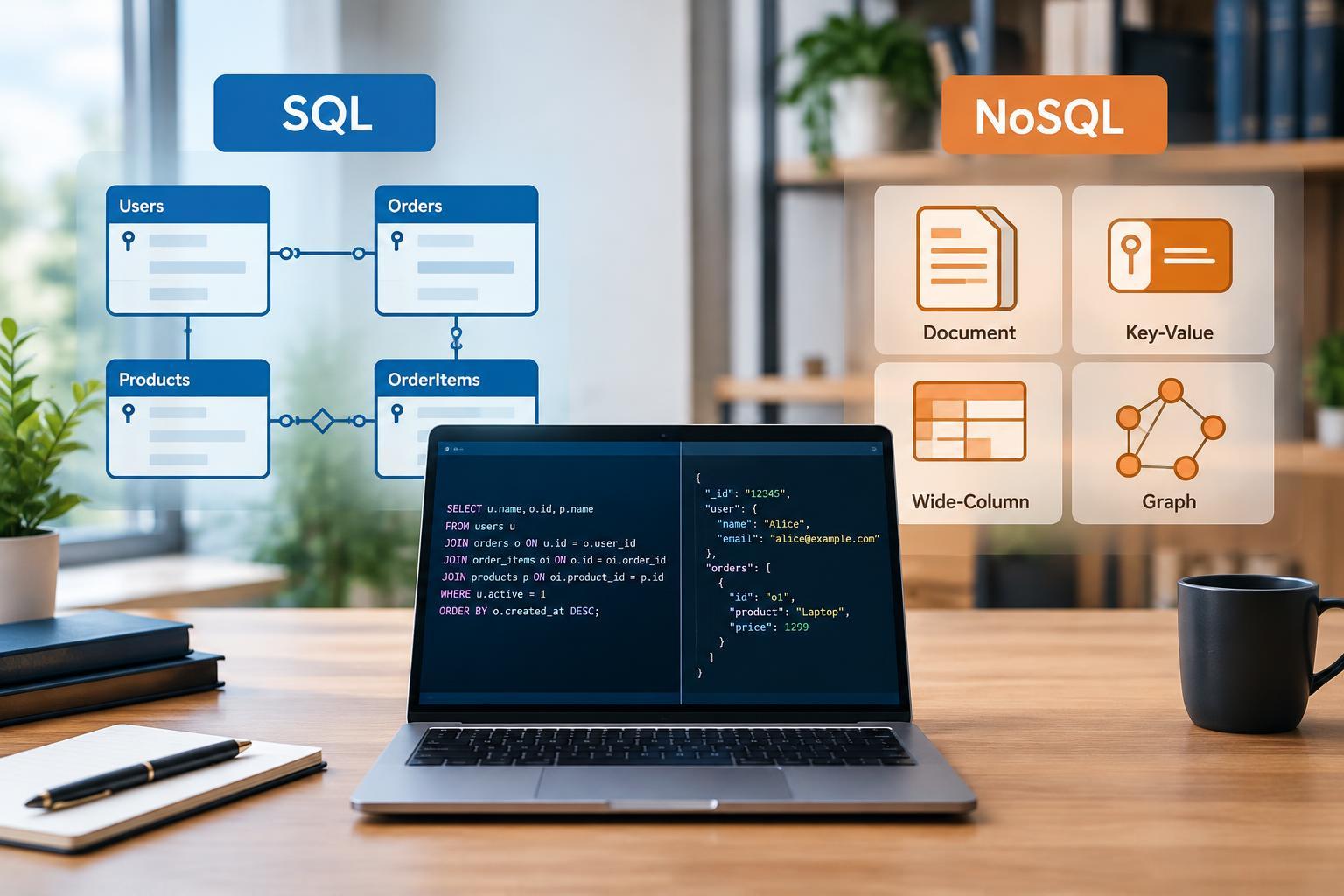
1. Start with the Workload, Not the Label
SQL versus NoSQL is often presented as a choice between strict structure and flexibility. That shorthand misses important differences. SQL is a query language associated with relational databases, while NoSQL is an umbrella term covering several nonrelational data models. Neither label, by itself, tells you how a database scales or what consistency guarantees it provides.
A useful comparison starts with application requirements: what data you store, how you retrieve it, which updates must succeed together, and how much temporary disagreement between readers is acceptable. An order-management system, a content catalog, and a relationship-analysis tool may need different capabilities even when they serve the same business.
2. Data Models Shape How Information Fits Together
Relational databases organize data into tables with defined columns. Primary keys identify rows, and foreign keys can enforce relationships between tables. Normalization separates facts to reduce duplication: customers live in one table, orders in another, and order items in a third. This supports integrity and allows the same information to be combined in different ways.
NoSQL databases offer several alternatives. Document databases store records with nested fields and arrays. Key-value stores retrieve values using identifiers. Wide-column databases organize records around keys and column families, often with partition-aware access patterns. Graph databases model entities and their relationships directly, making traversal a central operation.
Flexible structure does not eliminate schema design; it moves some responsibility into application code, validation rules, or conventions. Embedding an address inside an order document can simplify reads and preserve a historical snapshot. Copying a customer's current contact details into many documents, however, creates an update problem. Whether duplication is useful depends on what those fields mean.
3. Query Flexibility Versus Access-Pattern Optimization
SQL provides a widely understood way to filter, join, group, and aggregate data. Relational systems are often a strong fit when requirements include exploratory reporting or queries that change over time. Indexes and execution plans still matter: expressive queries are not automatically efficient, particularly when they scan large tables or combine poorly indexed relationships.
NoSQL query capabilities vary substantially. A key-value store may primarily support lookups by key, while a document database may offer rich filtering and aggregation. Graph query languages focus on connected data. Some nonrelational systems support joins or SQL-like interfaces, so it is important to inspect the actual product rather than assume a fixed feature set.
Many NoSQL designs reward planning around known access patterns. To display a user's recent activity, for example, records might be partitioned by user and ordered by time. That can make the intended query efficient, while a new requirement to search all users by another attribute may need another index, duplicated data, or a separate processing path.
4. Separate Transactions from Distributed Consistency
Transactions group operations into a unit of work. Their guarantees are commonly summarized as ACID: atomicity, consistency, isolation, and durability. Here, consistency means preserving defined rules and invariants; it is not the same as consistency between distributed replicas. Relational databases commonly support multi-row transactions, and some NoSQL systems also provide transactions across multiple records.
Isolation determines how concurrent transactions interact. A database can support ACID transactions while offering multiple isolation levels with different behavior. If two requests attempt to reserve the last available item, correctness may depend on an atomic conditional update, a constraint, locking, or an appropriate isolation level—not simply on choosing SQL.
Replica consistency concerns what readers observe after writes. Strong consistency can make operations behave as though they act on one up-to-date copy, while eventual consistency permits temporary differences that converge if updates stop. During a network partition, a distributed system cannot guarantee both linearizable consistency and a successful response to every request at reachable nodes. This trade-off applies to distributed SQL and NoSQL alike.
5. Scaling Includes Operational Trade-Offs
The idea that SQL scales vertically while NoSQL scales horizontally is too simplistic. Relational systems can use replicas, partitioning, sharding, and distributed architectures. Many NoSQL systems are designed for distribution, but adding nodes does not automatically solve uneven traffic, expensive queries, or poorly chosen partition keys.
Evaluate the work behind the architecture. Replicas can expand read capacity but may introduce stale reads, depending on configuration. Sharding distributes data, yet cross-shard queries and transactions can become more complex. Backups, restore testing, observability, migrations, and team familiarity all affect whether a system is manageable. A simpler deployment that meets requirements may be preferable to theoretical scalability.
6. Make the Choice with a Small, Realistic Test
Start by listing essential queries, expected data relationships, required transaction boundaries, and acceptable staleness. A relational database is often a practical default for applications with interconnected entities and evolving reporting needs. Consider a specific NoSQL model when its strengths closely match the workload, such as key-based retrieval, nested aggregates, or relationship traversal.
Test representative data and concurrent operations, not just isolated read speed. Check slow queries, failure behavior, recovery procedures, and the effort required to introduce a new access pattern. Using multiple database types can be justified, but it adds synchronization and operational costs. Choose the smallest architecture that satisfies your correctness and performance requirements, then expand when a demonstrated need appears.