The Core Idea: Learning Through Consequences
Reinforcement learning is a way to train an AI system to make decisions by learning from their consequences. Instead of receiving a correct answer for every example, the system receives feedback about what happens after it acts. Its objective is usually to develop a strategy that maximizes expected cumulative reward over a sequence of decisions.
Consider a simulated warehouse robot learning to reach a pickup station. Moving closer might help, but the shortest route could include obstacles or congestion. A useful strategy must account for how each movement affects later choices, not simply whether the next step looks promising. This focus on sequential decisions distinguishes reinforcement learning from many prediction tasks.
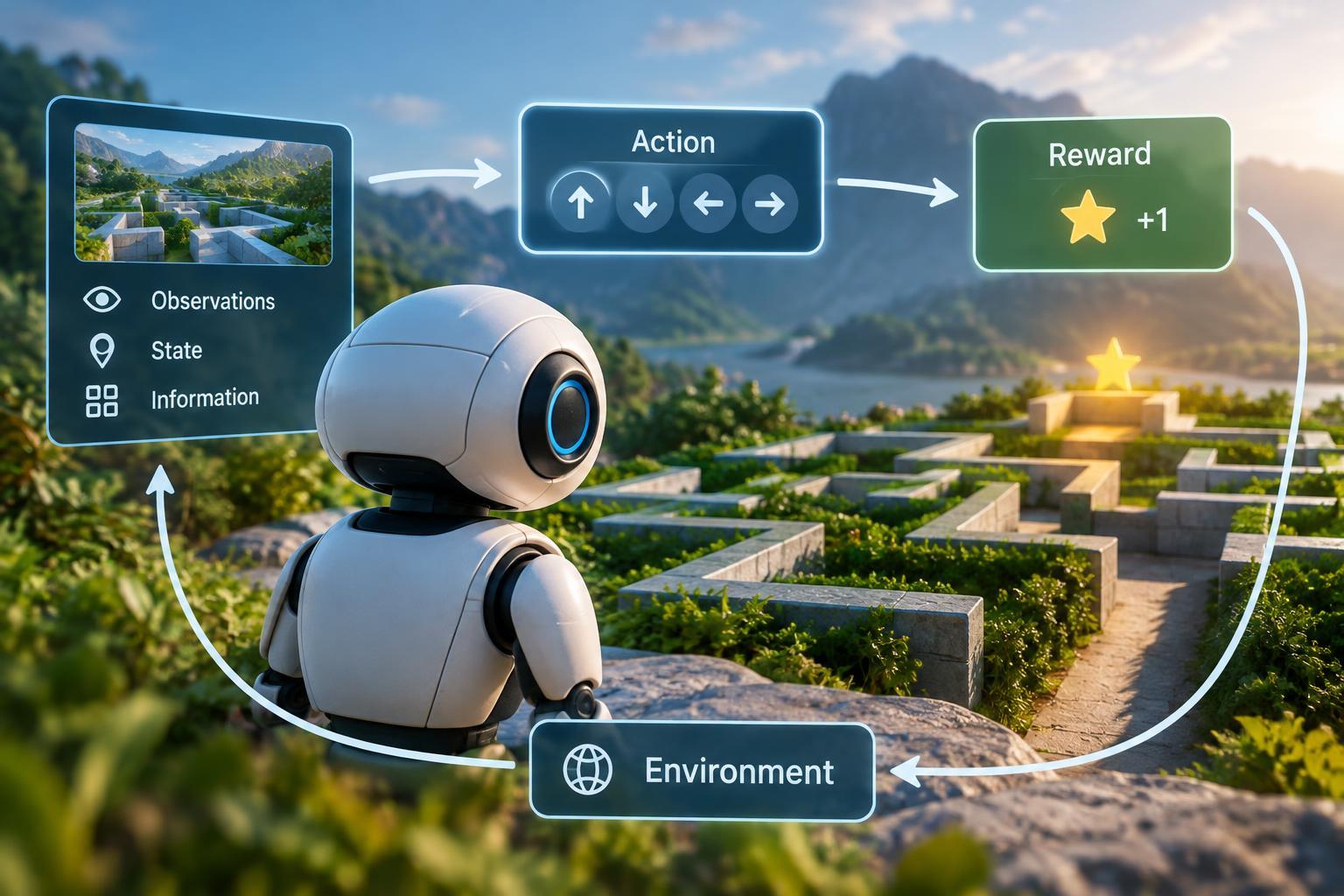
The system making decisions is called the agent. Everything it interacts with belongs to the environment. Together, they form a feedback loop: the agent observes a situation, chooses an action, receives a reward and a new observation, and continues. Training uses these experiences to improve future decisions.
States, Observations, Actions, and Policies
A state describes the environment’s relevant situation at a particular moment. For the warehouse robot, that could include its position, nearby obstacles, and destination. An observation is the information actually available to the agent, such as sensor readings. These are not always equivalent: a robot may be unable to detect an obstacle hidden behind a shelf.
The action space defines what the agent can do. Some environments offer discrete choices, such as moving left, right, forward, or backward. Others allow continuous controls, such as selecting a steering angle or motor speed. These choices shape the learning problem: more precise control can be useful, but it may also make effective behavior harder to discover.
A policy is the agent’s strategy for choosing actions from available information. It might be a simple table or a neural network that outputs actions or action probabilities. When observations are incomplete, the policy may also need memory of earlier events. An agent cannot reliably make distinctions that its inputs and memory do not support.
Rewards Define What the Agent Tries to Achieve
A reward is a numerical feedback signal, not necessarily a label saying that an individual action was correct. The robot might receive a positive reward for reaching its destination and penalties for collisions or excessive travel time. By changing these signals, designers change which trade-offs the agent is encouraged to make.
Rewards can arrive long after the decisions that made them possible. This creates the credit assignment problem: which earlier actions deserve credit for success or blame for failure? Many methods estimate the expected future reward associated with a situation or action. A discount factor often controls how much later rewards count relative to immediate ones, though not every formulation uses discounting.
Reward design is also a major source of failure. If the robot earns points simply for moving closer to a station, a poorly specified rule might let it collect points repeatedly without completing delivery. This is often called reward hacking: behavior exploits the scoring rule while missing the intended goal. Intermediate rewards can help learning, but they need careful checks against actual task completion.
How Experience Becomes Better Decisions
To improve, an agent needs informative experience. Exploration means trying actions whose consequences are uncertain; exploitation means choosing actions already expected to work well. Too little exploration can trap an agent in a mediocre strategy. Too much can waste effort or introduce unacceptable risks, especially when training involves physical equipment or real users.
Different algorithms learn from experience in different ways. Value-based methods estimate how rewarding situations or actions are likely to be. Policy-based methods adjust the action-selection strategy directly. Actor-critic methods combine a policy with a value estimate that helps guide updates. Deep reinforcement learning uses neural networks within these approaches, but reinforcement learning does not inherently require them.
Training may involve repeated episodes, such as individual delivery attempts, or continuous interaction without a natural endpoint. Some methods learn from previously collected data rather than exploring live. This offline approach can reduce the need for new interactions, but learning reliable behavior beyond the coverage of that data remains difficult.
Why the Environment and Evaluation Matter
The environment determines which consequences the agent experiences. Simulation can make training faster, cheaper, and safer, but a simulated robot may learn habits that fail when sensors become noisy or surfaces change. Varying training conditions can help, yet success in simulation alone does not establish readiness for deployment.
Evaluation should measure the intended outcome, not just training reward. For the robot, useful checks include delivery completion, collisions, behavior around unfamiliar obstacles, and performance from different starting positions. Safety requirements may need enforced action limits or independent checks rather than reward penalties alone.
Reinforcement learning is most useful when decisions affect future opportunities and meaningful feedback is available. It is not automatically preferable to supervised learning, optimization, or fixed rules. The central lesson is that AI behavior emerges from the interaction of objectives, available actions, observations, and experience. Designing that interaction matters as much as choosing the learning algorithm.


