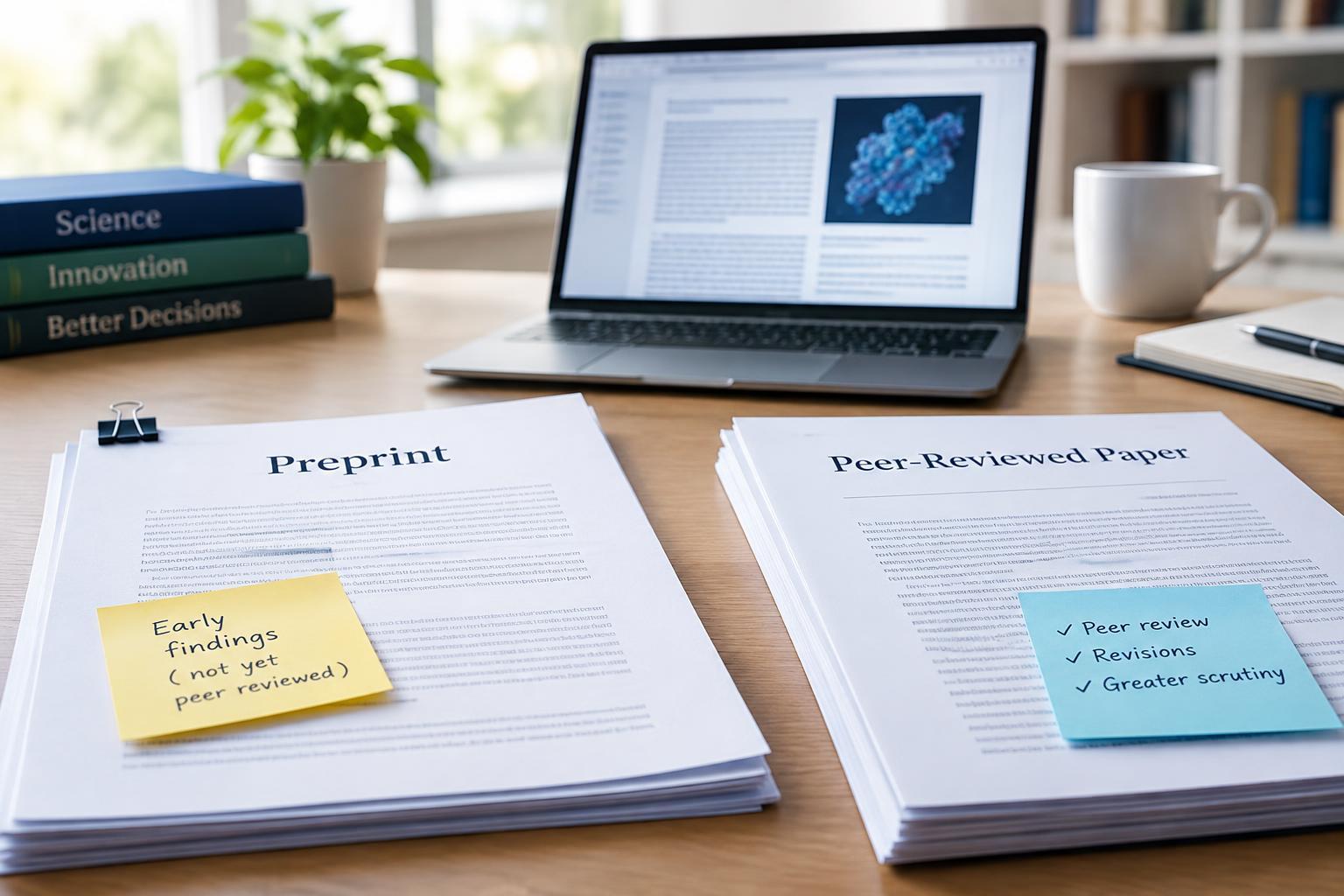
Publication Status Is a Clue, Not a Verdict
A science headline may announce a promising discovery, a surprising risk, or a new artificial intelligence capability. Before asking whether the finding changes everything, ask a simpler question: what stage has the research reached? A paper shared as a preprint has a different review history from one published after peer review, even when both describe the same experiment.
Publication status tells you something about the checks a manuscript has passed. It does not, by itself, establish whether the conclusions are correct. A carefully conducted preprint can provide stronger evidence than a weak peer-reviewed study. The useful distinction is not “unreliable versus reliable,” but which safeguards have been applied and what uncertainty remains.
What a Preprint Does—and Does Not—Mean
A preprint is a research manuscript made publicly available before completing formal journal peer review. It allows researchers to share methods and findings while journal submission and review are still ahead or underway. Practices vary across disciplines, and authors may update the manuscript as they receive feedback.
Preprint servers commonly perform some screening, but screening is not equivalent to expert evaluation of the study’s methods and conclusions. A publicly accessible paper with technical language, charts, and a permanent identifier may still contain mistakes that have not been examined by independent reviewers.
Early sharing has real benefits. Other researchers can inspect the work, attempt replication, identify weaknesses, or build on the methods without waiting for journal publication. For news readers, however, the appropriate framing is provisional: the authors report a result, and its interpretation may change. Check the version as well as the label, because an older preprint may differ from a revised manuscript or a later journal article.
What Peer Review Adds
In conventional journal peer review, editors ask researchers with relevant expertise to assess a submitted manuscript. Reviewers may question the experimental design, statistical analysis, interpretation, or clarity of reporting. Authors can be asked to revise their claims, supply additional analysis, or perform further experiments before acceptance.
This process can improve a paper substantially, but its depth and procedures vary. Reviewers do not ordinarily repeat every experiment or independently audit every underlying data point. They may miss errors, lack access to important materials, or disagree about whether the evidence supports the conclusions. Peer review is a quality-control process, not a certification of truth.
Publication also does not end scrutiny. Other teams may test the result under different conditions, uncover limitations, or challenge an analysis. Published papers can receive corrections or be retracted. Some conference proceedings, particularly in computing, also use substantial peer review, so “journal article” and “reviewed research” are not interchangeable labels.
Look Beyond the Label to the Evidence
Start with the match between the headline and the study. Research in cells does not directly establish an effect in people. An observational association does not, on its own, prove causation. An AI system performing well on a benchmark does not necessarily perform well in everyday use. These gaps matter whether the paper is a preprint or peer-reviewed.
Next, look at how the result was produced. Relevant questions include whether the comparison was fair, whether the sample fits the claim, and whether uncertainty and limitations are explained. In AI research, useful details include the evaluation data, baseline systems, and possible overlap between training and test material. In experimental science, controls and measurement procedures may be central.
Finally, consider the wider evidence. One study rarely settles a broad question. Independent replication and agreement across different methods generally provide more confidence than repeated coverage of the same paper. Available data and code can make scrutiny easier, although their presence alone does not establish that an analysis is sound.
A Practical Way to Read the Next Science Story
Find the underlying paper when it is linked, and check whether the story identifies it as a preprint, an accepted manuscript, or a published article. A press release, conference talk, or company announcement is not itself evidence of peer review. If the status is unclear, treat that as missing information rather than assuming the strongest level of scrutiny.
Read the abstract alongside the limitations or discussion, then compare their wording with the headline. Words such as “suggests,” “may,” and “under these conditions” often carry important boundaries. Check for a newer version, a correction, or a linked journal publication when those details are available.
The best response is calibrated confidence, not automatic trust or dismissal. An interesting preprint can merit attention without justifying a sweeping conclusion. A peer-reviewed paper can deserve serious consideration without being the final word. Reliable science coverage makes both the finding and its limits visible—and leaves room for the evidence to change.