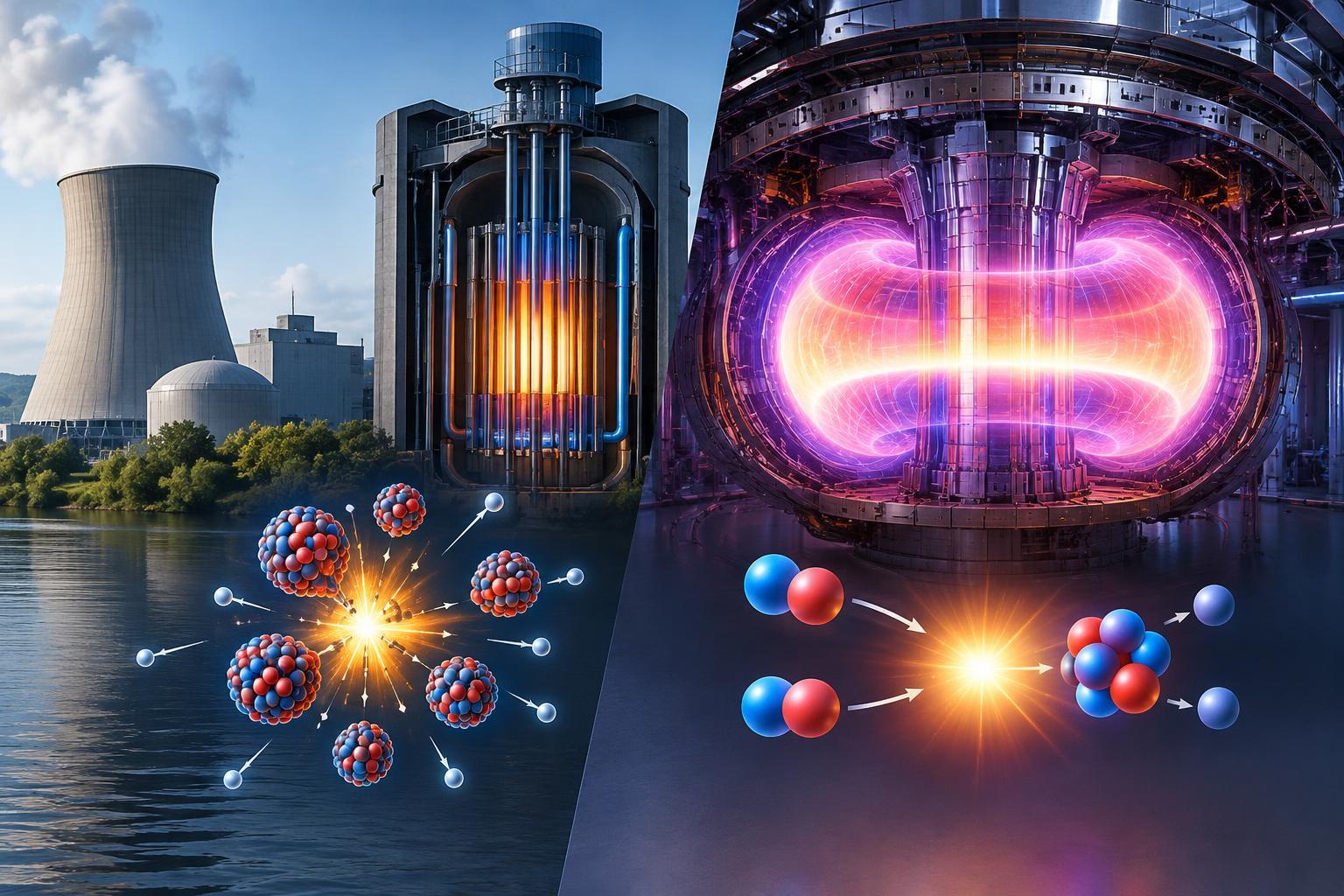
Two Different Routes to Nuclear Energy
Fission and fusion release energy by rearranging atomic nuclei into more tightly bound configurations. Binding energy describes how strongly protons and neutrons are held together. When a reaction produces a more tightly bound overall arrangement, some of the initial mass becomes released energy, following Einstein’s relationship between mass and energy.
Fission achieves this by splitting a heavy nucleus into smaller nuclei. Fusion combines light nuclei into heavier ones. Both processes move toward the region of greater binding energy per nucleon near iron and nickel, though their individual reaction pathways differ. Neither involves ordinary chemical burning: chemical reactions rearrange electrons, while nuclear reactions change nuclei. This distinction explains why relatively small quantities of nuclear fuel can release much more energy than comparable masses of chemical fuel.
Fission: Neutrons Sustain a Chain Reaction
In a typical fission reactor, a neutron is absorbed by a fissile nucleus, such as uranium-235, which can then split. The reaction produces two main fragments, additional neutrons, and energy. Most of the immediate energy appears as motion of the fragments and becomes heat as they slow down in the fuel. Some released neutrons trigger further fissions, creating a chain reaction.
Reactor control depends on managing those neutrons. In many designs, a moderator slows them down to make further fission more likely, while control rods absorb them. Other designs operate with fast neutrons and no moderator. A steady reactor maintains a balanced chain reaction rather than an accelerating one. Shutting down that chain reaction does not eliminate heat immediately: radioactive fission products continue decaying, so cooling remains necessary after shutdown.
Fusion: Overcoming Electrical Repulsion
Fusion requires positively charged nuclei to approach closely enough for the strong nuclear force to bind them, despite their electrical repulsion. High temperatures give nuclei greater kinetic energy, while quantum tunneling allows some to react without classically overcoming the full barrier. For useful energy production, enough reactions must occur before the fuel loses its energy.
The most widely pursued fuel combination for near-term fusion power is deuterium and tritium, two hydrogen isotopes. Their reaction produces a helium-4 nucleus and a high-energy neutron. Magnetic-confinement systems aim to hold a hot plasma away from material walls; inertial-confinement systems briefly compress and heat small fuel targets. Neither temperature alone nor a single burst of fusion establishes a practical power plant. Sustained operation, component durability, fuel supply, and overall electricity balance also matter.
Fuel Requirements: Abundance Is Only Part of the Story
Most commercial fission reactors use uranium fuel enriched to increase its share of uranium-235. Uranium-238, the more abundant isotope, is fertile: it can absorb a neutron and ultimately become plutonium-239, which is fissile. Some reactor fuel cycles use plutonium. Thorium is likewise a potential fertile resource rather than a direct substitute for fissile starting fuel; it must be converted into uranium-233 within an appropriate fuel cycle.
For deuterium–tritium fusion, deuterium can be extracted from water, but tritium is scarce and radioactive. A power plant using this reaction would generally be expected to breed tritium from lithium in a surrounding blanket. Producing, recovering, and recycling enough tritium is a central engineering challenge, not an automatic consequence of fusion. Alternative fuels could reduce reliance on tritium or neutron production, but generally require more demanding reaction conditions.
Radioactive Byproducts: Different, Not Absent
Fission creates a mixture of fission products, many of which are radioactive. Neutron absorption also produces heavier elements, including plutonium and other actinides. Spent fuel therefore contains materials with widely varying half-lives, heat output, and radiation characteristics. Its management requires cooling, shielding, containment, and an appropriate long-term strategy. Reprocessing changes the waste streams but does not remove the need to manage radioactive waste.
Deuterium–tritium fusion does not generate the same mixture of fission fragments and heavy actinides. However, its neutrons can activate structural materials, making reactor components radioactive, and tritium requires careful containment. The resulting waste depends strongly on material composition, impurities, neutron exposure, and component replacement. Carefully chosen materials may reduce the long-lived waste burden compared with fission, but describing fusion as producing no radioactive waste is misleading.
What These Differences Mean for Power Plants
Fission and fusion both turn nuclear energy into usable power, usually through heat transfer and electricity generation. Their operating hazards differ. Fission requires control of a self-sustaining chain reaction and reliable removal of decay heat. Fusion conditions are difficult to maintain, so disrupting them stops the main reaction quickly. Nevertheless, activated components, tritium inventories, stored energy, and coolant systems still require engineered protection.
The useful comparison is therefore not simply “dirty versus clean.” Fission has an established electricity-generating role alongside demanding fuel and waste responsibilities. Fusion offers a different fuel cycle and potentially favorable waste characteristics, but practical deployment depends on resolving interconnected physics and engineering challenges. Reaction performance, fuel availability, materials lifetime, and radioactive byproducts all belong in the assessment.