Three Tasks, Three Levels of Detail
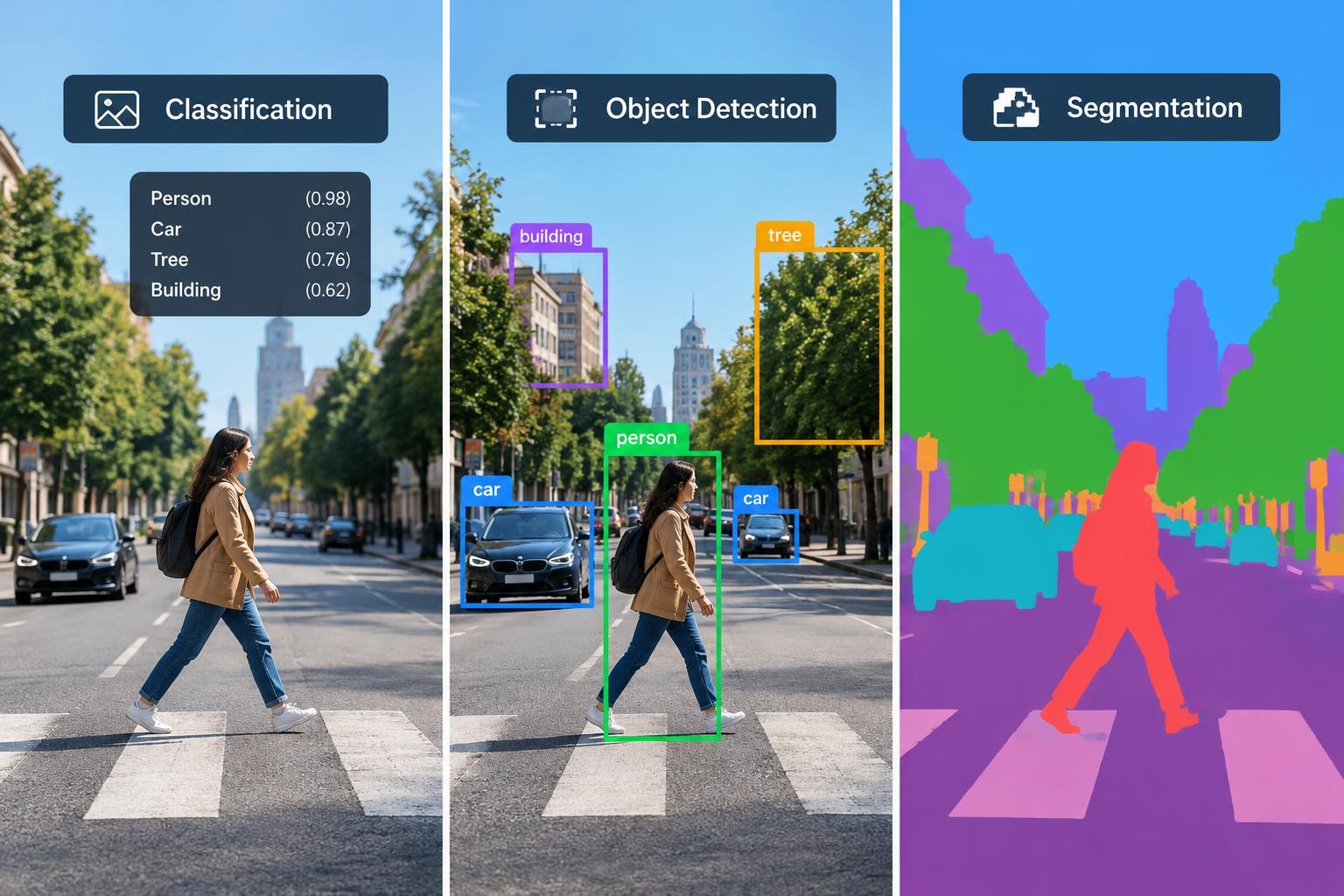
Computer vision systems turn images into structured information, but not every application needs the same kind of answer. Image classification asks, “What is in this image?” Object detection asks, “What objects are present, and where are they?” Segmentation asks, “Which pixels belong to which category or object?” These differences determine what a model produces and how much detail its predictions contain.
Imagine a photograph of several apples on a conveyor belt. A classifier might label the image “contains damaged fruit.” A detector could draw a box around each apple and label it as damaged or undamaged. A segmentation model could outline each apple or identify the precise region of visible damage. None of these tasks is universally better; each supports a different decision.
The practical starting point is therefore not choosing a model architecture. It is defining the output your application actually needs. A system that routes images into folders may need only labels, while a robot picking fruit may need object locations or detailed boundaries.
Image Classification: Assigning Labels to an Image
Image classification assigns one or more categories to an entire image. In single-label classification, the model selects from mutually exclusive categories, such as “indoor” or “outdoor.” In multi-label classification, several categories can apply at once, such as “person,” “bicycle,” and “road.” Models typically output scores that an application converts into labels using a selection rule or threshold.
Classification is useful for sorting visual content, recognizing broad scene types, or checking whether a product image shows an expected condition. Its labels describe the image as a whole rather than providing object locations. A prediction of “three people present,” if that is a trained category, still does not identify where those people are.
Training data commonly consists of images paired with category labels, making annotation relatively straightforward compared with drawing boxes or masks. Evaluation should go beyond overall accuracy when categories are unevenly represented. Precision and recall for each category can expose failures hidden by a strong average score. A classifier that misses rare defects may be unsuitable even if it handles ordinary products well.
Object Detection: Finding and Labeling Individual Objects
Object detection predicts a set of object locations, usually represented as rectangular bounding boxes. Each prediction typically includes a category and a confidence score. Unlike classification, detection can distinguish multiple occurrences of the same category within one image, making it useful for tasks such as counting visible packages or locating components during inspection.
Bounding boxes provide useful spatial information without tracing exact shapes. However, they often include background pixels, and overlapping objects can be difficult to separate. Small objects, partial obstruction, motion blur, and unusual viewpoints can also reduce reliability. Counting detections is not automatically equivalent to counting every real object, especially when some objects are hidden.
Detection datasets generally require a labeled box around every relevant visible object. Evaluation must assess both category correctness and location quality. Intersection over union measures how much a predicted box overlaps a reference box relative to their combined area. Average precision summarizes detection performance under specified matching rules, so comparisons require consistent evaluation settings.
Segmentation: Understanding Images at Pixel Level
Segmentation produces pixel-level labels or masks rather than only rectangles. Semantic segmentation assigns each pixel a category, such as road, vegetation, or building, without distinguishing separate objects of the same category. Instance segmentation separates individual objects, so two neighboring cars receive different masks even though both belong to the “car” class.
Panoptic segmentation combines these ideas: it separates individual countable objects while also labeling background regions such as sky or pavement. The distinction matters in practice. Measuring the visible area covered by vegetation may call for semantic segmentation, while outlining each leaf separately calls for instance segmentation.
Detailed masks can support boundary-sensitive inspection, image editing, and scene analysis. They also tend to require more annotation effort, particularly when edges are ambiguous or objects overlap. Common evaluation measures include pixel intersection over union and the Dice score, which assess mask overlap. Yet a good overlap score may still hide an important boundary error, so evaluation should reflect how the masks will be used.
How to Choose and Validate the Right Approach
Choose the least detailed output that reliably supports the next step. Use classification when an image-level decision is sufficient, detection when you need object locations or visible-object counts, and segmentation when shape or pixel coverage matters. Greater detail is not free: it can increase labeling, validation, and deployment complexity, although actual runtime depends on the model and image resolution.
Tasks can also be combined. A detector might locate products before a classifier examines each crop for defects. Whatever the approach, test on representative lighting, backgrounds, cameras, and difficult cases. Keep closely related images out of different training and test splits to avoid misleading results. Finally, define what happens when predictions are uncertain: review, retry, or a safe fallback may matter more than a small improvement in an aggregate metric.


