1. Separate the Headline from the Actual Finding
Data breach reports often compress several different events into one headline. A publicly accessible database, a compromised employee account, and stolen customer records can all be described as a breach, but they do not establish the same facts. Start with the report’s specific technical claims rather than its broad label.
Identify what happened, which system was involved, and whose information may have been affected. An incident at a service provider does not automatically mean every customer organization lost data. Likewise, access to an organization’s network does not prove access to every database on that network. Look for a clear connection between the compromised system and the information discussed.
Then identify who is making each claim. An organization’s notice, an investigator’s assessment, and an attacker’s allegation are different kinds of evidence. A news article may combine all three. Keep those statements separate: an attacker advertising a dataset is making a claim, not independently establishing its authenticity, completeness, or origin.
2. Distinguish Exposure, Access, and Exfiltration
Exposure generally means information was available to someone who should not have been able to reach it. For example, a storage location might allow public retrieval because of an incorrect permission setting. Confirming that condition establishes a security failure, but it does not necessarily establish that an unauthorized person retrieved the information. The duration and scope of that exposure still matter.
Access means a person or process reached a system or resource. Read carefully to see what was accessed: a login account, a file directory, or the contents of particular records. Evidence of a successful unauthorized login may be strong evidence of account compromise while leaving subsequent activity uncertain. Reports sometimes use access loosely, so the supporting description is more useful than the word alone.
Exfiltration means data was transferred out of the affected environment without authorization. Supporting evidence might include transfer logs or recovered copies. Confirmed theft is a stronger finding than possible access, but its scope can remain unclear. Conversely, information can be viewed or misused without a bulk download, so a lack of confirmed exfiltration does not establish that nothing harmful happened.
3. Read Uncertainty as a Statement About Evidence
Phrases such as may have been accessed and cannot rule out indicate uncertainty, not a measured probability. They can reflect incomplete logs, missing monitoring, or an investigation that has not yet established what happened. Do not translate them into either definite theft or definite safety.
A statement that investigators found no evidence of data theft needs context. Did monitoring cover the relevant systems and time period? Were logs retained and reliable? If the available records could not show downloads, the absence of a download record offers limited reassurance. If relevant activity was comprehensively recorded and examined, the same statement may carry more weight.
Distinguish unanswered questions from contradictory claims. An early notice may identify affected systems before investigators can identify affected records. A later update can narrow or expand the scope without necessarily invalidating everything previously reported. Track what changed and why, while recognizing that some questions may remain unresolved.
4. Check the Data Types, Counts, and Timeline
The category of information often matters more than the headline total. Email addresses, passwords, private messages, identity documents, and payment details present different risks. Also check whether the listed fields were affected for everyone or only some individuals. A report describing multiple data types does not necessarily mean every affected record contained all of them.
Treat large counts carefully. Records, accounts, and people are not interchangeable: one person may have multiple accounts, and one account may generate many records. Ask whether the number describes a potentially accessible database, confirmed extracted files, or an attacker’s claim. For protected data, encryption and password hashing are relevant safeguards, but their effectiveness depends on implementation and whether keys or other secrets were also compromised.
Separate the incident period from discovery, containment, and notification. These are different milestones. Closing an exposed service can stop that route of access, but it cannot retrieve copies already taken. Similarly, restoring operations does not establish that the investigation is complete.
5. Turn the Report into Proportionate Next Steps
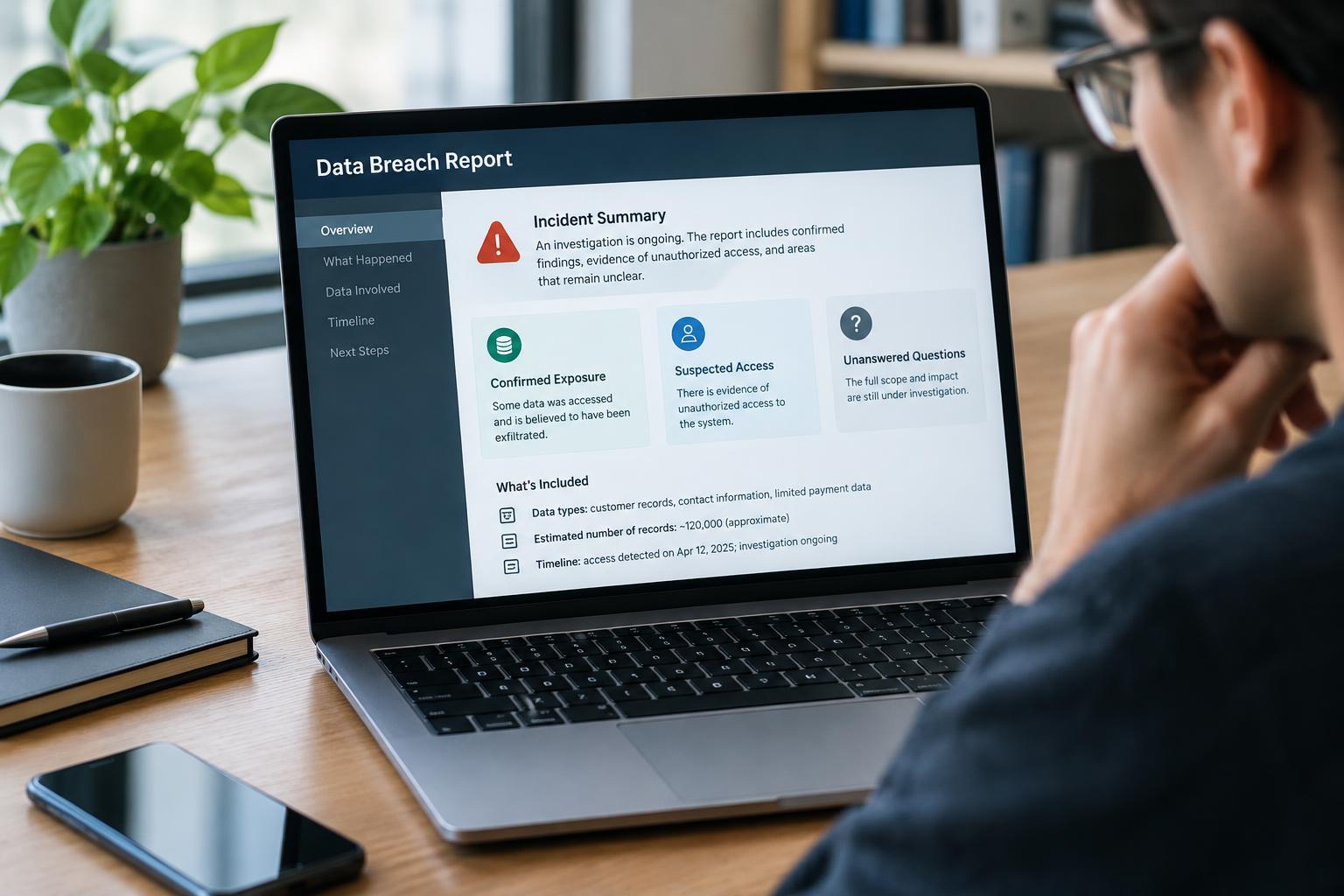
Summarize the report under three labels: confirmed facts, suspected activity, and unanswered questions. Include the affected systems, data categories, evidence described, and actions the organization says it has taken. This simple separation makes it harder for alarming headlines—or overly reassuring language—to substitute for the actual findings.
Follow relevant instructions through a verified channel, such as the organization’s official app or a website you navigate to independently. Be cautious with unsolicited breach-related messages. If passwords are affected, change the relevant password and any reused copies; enable multifactor authentication where available. For other exposed information, watch for targeted impersonation and account alerts. Revisit official updates, matching your response to the reported facts rather than waiting for perfect certainty or assuming the worst.


