Separate the picture from the claim
A news photo or video does not need to be digitally altered to mislead. An old flood clip can be presented as a new disaster, a demonstration can be assigned to another country, or footage from a film can be described as a real emergency. The first question is therefore not simply whether the image is authentic, but whether it supports the accompanying claim.
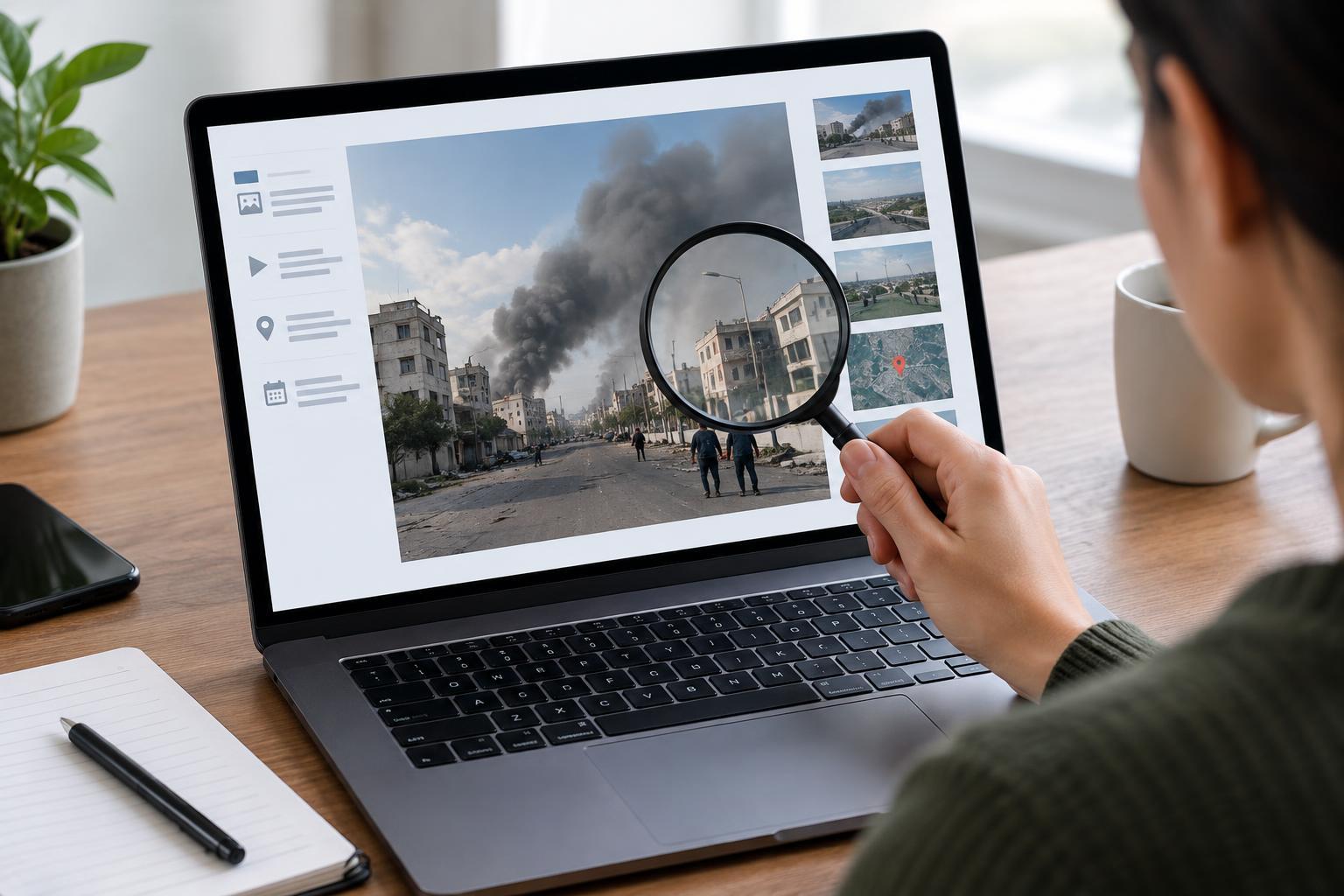
Write down the claim’s separate parts: the alleged location, date, event and participants. Then distinguish what is actually visible from what the caption supplies. A clip may clearly show smoke and a crowded street without establishing the city, cause or people involved. Keep the post’s link, account name and caption for reference, and treat each unsupported detail as something to check rather than a fact.
Trace the image to an earlier source
Use a reverse image search to look for earlier appearances of a photograph. For video, pause at several distinctive moments and search screenshots of those frames. Choose views containing recognizable buildings, signs or unusual objects rather than generic sky or crowds. If borders or captions dominate the image, try searching a cropped version as well. Different search services may return different matches, so one unsuccessful search settles little.
Compare the surrounding information on matching pages, not just their pictures. Does an earlier version describe another place or event? Is there a longer clip that explains what happened before the shared extract? The earliest result you find is not necessarily the original: older material may be unindexed, deleted or privately shared. Likewise, an upload date establishes when that copy was posted, not necessarily when it was recorded.
Test the claimed location against visible details
Look for a combination of geographical clues: street names, transit signs, road markings, building shapes, mountain profiles and the arrangement of intersections. Language can narrow possibilities, but it rarely identifies a place on its own. Shop brands, vehicle models and architectural styles can also appear across many countries. Start with the most distinctive fixed feature, then compare its surroundings with available maps, street-level imagery or other independently sourced photographs.
A convincing location match should explain several details together. If a tower appears beside a curved road, check whether nearby buildings and junctions also align from the apparent camera position. Watch for mirrored footage, which reverses signs and street layouts. Map imagery may be old, and buildings or roads can change, so a mismatch needs interpretation. Avoid treating one similar-looking landmark as proof or publishing a private person’s precise whereabouts unnecessarily.
Check the timing and the event separately
Once a location looks plausible, test whether the scene belongs to the claimed occasion. Search for the location alongside distinctive event details, including relevant local-language terms when possible. Look for independently captured views that share temporary features: a particular banner, damaged structure, stage arrangement or road closure. Several accounts reposting the same clip do not provide independent confirmation.
Clothing, vegetation, weather and shadows can reveal inconsistencies, but they are usually supporting clues rather than precise clocks. Weather can vary locally, and estimating time from shadows requires reliable assumptions about location, orientation and the scene. Metadata in an original file may contain a timestamp or coordinates, but it can be missing, edited or based on incorrect device settings. Check time zones when comparing timestamps, and remember that proving where a scene occurred does not establish why it happened.
Look for edits that change the meaning
Watch the full sequence when available. A shortened clip can hide a rehearsal, a preceding confrontation or an explanation that changes its meaning. Check whether the audio appears continuous and synchronized, while allowing for ordinary recording or playback delays. Subtitles, voiceovers and on-screen labels are additional claims; they are not evidence merely because they are embedded in the video.
Visible oddities can justify further checking, but compression, motion blur and poor lighting can also produce strange details. AI-generated media detectors and other automated tools should be treated as leads, not verdicts. Their outputs do not establish a location or event, and both authentic and synthetic material can be misclassified. Stronger verification comes from a traceable source, matching geography, consistent context and genuinely independent evidence.
Reach a conclusion that matches the evidence
Keep a short record of what supports the claim, what contradicts it and what remains unknown. Use specific conclusions: “This appears to show the stated intersection, but the recording date is unconfirmed” is more useful than declaring the whole post true or false. Distinguish an unsupported claim from a disproven one.
Before sharing, ask whether your wording would turn uncertainty into apparent fact. If the place, timing or event remains unresolved, pause rather than repeat the original caption. If you already shared a misleading version, correct it clearly. The goal is not to solve every image, but to prevent a compelling picture from carrying more certainty than the evidence allows.