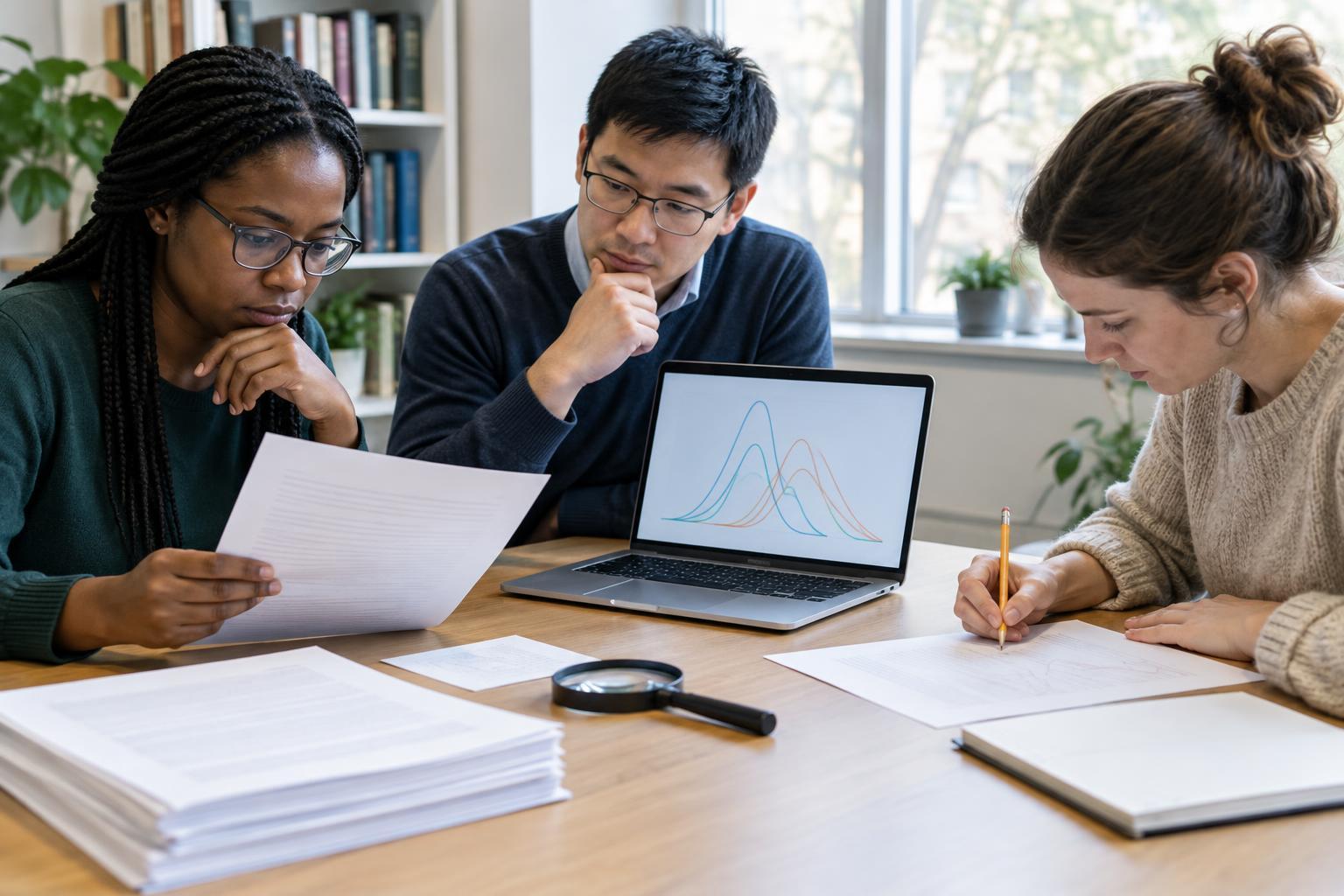
What happens before a paper is published
When researchers submit a manuscript to a scientific journal, an editor first decides whether it fits the journal’s scope and meets basic submission requirements. A manuscript may be declined at this stage without being sent to outside reviewers. If it moves forward, the editor invites people with relevant expertise to assess the work. This process is called peer review.
Reviewers generally examine whether the research question is clear, the methods are described well enough to assess, the analysis fits the data, and the conclusions acknowledge important limitations. They may also identify missing comparisons, unclear figures, or alternative explanations. Their task is not necessarily to repeat the experiment or independently verify every measurement; they are evaluating the evidence and reasoning presented to them.
After receiving the reviews, the editor may reject the manuscript, request changes, or accept it. A request for revisions is not the same as acceptance. Authors typically respond to each concern and submit a revised manuscript, which the editor or reviewers may assess again. The editor makes the publication decision, while authors remain responsible for the content of their paper.
Why reviewers sometimes disagree
A study can be sound in one respect and weak in another. One reviewer may focus on whether the experimental controls are adequate, while another concentrates on statistical analysis or how broadly the conclusions are stated. Specialists can also make different judgments about whether an uncertainty is minor, fixable, or central to the result.
Disagreement does not automatically mean the process has failed. Specific questions from reviewers can help authors clarify methods, narrow claims, or add useful checks. At the same time, reviewer feedback reflects human judgment. Reviewers have limited time and may not share exactly the same expertise, so their comments should not be treated as an exhaustive inspection of every part of a study.
Review practices also vary. In some arrangements reviewers know the authors’ identities; in others, one or both sides have identities concealed during review. Some journals publish reviewer reports and author responses, while others keep that exchange private. These differences can affect what readers are able to see about how a manuscript changed before publication.
What peer review can and cannot establish
Peer review can catch problems before they reach readers. A reviewer might notice that a conclusion goes beyond the observations, that a method needs more detail, or that an important comparison has been overlooked. Revision can make the published paper clearer and more cautious even when its central result remains unchanged.
But a peer-reviewed label is not a certificate of truth. Reviewers usually work from the manuscript and materials available to them; they may not have access to every underlying detail or the means to reproduce an entire project. Errors, ambiguous results, and unsupported interpretations can survive review. Conversely, rejection by one journal does not by itself show that a study is wrong: editorial fit and judgments about contribution can also matter.
Scientific confidence is better understood as something that develops beyond a single publication. Other researchers may test a result using different methods, investigate its boundary conditions, or find reasons to revise its interpretation. A paper can be a valuable contribution while still leaving substantial questions open.
How to read a peer-reviewed paper with care
Start with the question the authors actually studied. Who or what was examined, under which conditions, and what was measured? Then compare the results with the conclusion. A finding in a narrow setting may be useful without applying to every setting that sounds similar. Pay particular attention to limitations identified by the authors and to plausible explanations they could not rule out.
It also helps to distinguish observations from interpretation. A graph or table presents analyzed evidence, while the discussion explains what the authors think it means. Ask whether the claimed effect depends on a particular choice of measurement or analysis, and whether the paper describes enough detail for others to scrutinize those choices. These questions are useful whether a result confirms or challenges your expectations.
Finally, treat publication status as one piece of context, not a substitute for reading. Peer review describes a screening and revision process; it does not tell you, on its own, how strong a particular claim is. The most useful takeaway from a paper is often more precise than “scientists proved it”: it is what the researchers found, under what conditions, and what remains uncertain.