Radioactive Decay Creates a Natural Clock
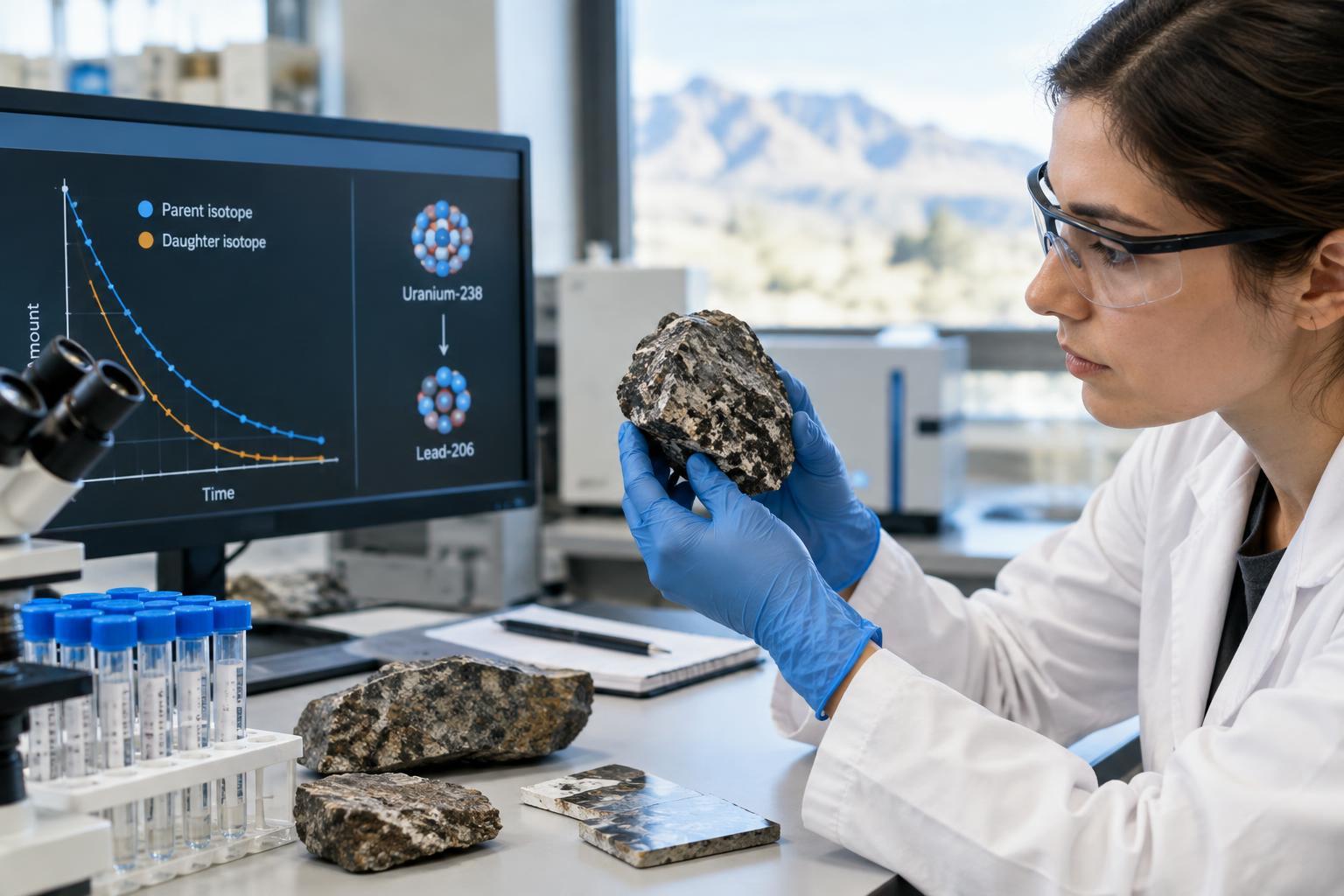
Radiometric dating estimates the time since a material recorded a particular event, such as a mineral crystallizing or an organism dying. It relies on isotopes: forms of the same element with different numbers of neutrons. Some isotopes are unstable and decay into other isotopes at predictable rates.
The radioactive isotope is called the parent; its decay product is called the daughter. Although the decay of an individual atom is unpredictable, a large population follows a well-understood statistical pattern. Ordinary changes in temperature, pressure, and chemical conditions generally do not meaningfully alter the decay rates used in geological dating.
The essential question is not simply how much radioactive material remains. Scientists must also establish the starting conditions and determine whether the sample retained the relevant isotopes. A dependable age requires both a measurable clock and a defensible account of what started it.
Half-Life Explains How the Clock Runs
A half-life is the time required for half of a population of radioactive parent atoms to decay. After one half-life, half remains; after two, one-quarter remains; after three, one-eighth remains. Decay is exponential, not a process that removes the same number of atoms each year.
Suppose a mineral originally contained a radioactive parent isotope and no daughter isotope. If it stayed closed to both, finding one parent atom for every three accumulated daughter atoms would mean that one-quarter of the original parent remains. The elapsed time would therefore be two half-lives.
Different isotopes provide clocks with very different speeds. Carbon-14 has a half-life of about 5,730 years, while uranium-238 has a half-life of about 4.47 billion years. A useful clock must produce a measurable change over the interval being studied: too little decay gives a weak signal, while too much can leave too little parent isotope to measure reliably.
Isotope Ratios Reveal More Than Raw Amounts
Laboratories commonly use mass spectrometry to distinguish isotopes and measure their relative abundances. Depending on the method, researchers compare parent and daughter isotopes, or compare them with a stable reference isotope. Ratios help account for differences in sample size and elemental concentration.
For parent–daughter dating, the important quantity is the daughter isotope produced by radioactive decay, not necessarily all the daughter isotope present. Some may already have existed when the mineral formed. Ignoring that initial component can make an age appear older than it really is.
One way to address this is an isochron approach. Several related minerals or samples with different parent-element concentrations are analyzed together. Under suitable assumptions, their isotope ratios define a relationship that reveals both an age and information about the initial daughter component. Agreement is useful evidence, but a line alone does not prove the interpretation: mixing and later alteration must also be considered.
Choose a Method That Fits the Material and Timescale
Radiocarbon dating suits once-living materials such as wood, seeds, and bone with preserved collagen. While alive, organisms incorporate carbon from their surroundings. After death, exchange largely stops and carbon-14 declines. Laboratories usually measure carbon-14 relative to stable carbon isotopes rather than measuring its nitrogen daughter. The method generally reaches back around 50,000 years, depending on preservation and measurement conditions.
Uranium–lead dating is widely used for suitable minerals, especially zircon. Zircon commonly incorporates uranium while excluding much lead during crystallization, making it a useful recorder of geological time. Two uranium decay chains provide opportunities to check whether the isotopic record has been disturbed.
Potassium–argon and argon–argon methods are useful for many volcanic rocks and minerals. They track argon produced by potassium-40 decay. Method selection also depends on mineral chemistry, expected age, and the event of interest. Sedimentary rocks often contain older mineral grains, so dating those grains may reveal their source history rather than when the sediment was deposited.
Check Whether the Clock Stayed Closed
A closed system neither gains nor loses the isotopes relevant to its clock. Heating, weathering, fluids, or deformation can move parent or daughter isotopes and alter an apparent age. Different minerals retain isotopes differently, so the same geological event may reset one clock while leaving another largely intact.
This makes the meaning of an age important. A result might record crystallization, cooling through an effective isotope-retention temperature, or later alteration. Scientists examine mineral textures, geological relationships, and multiple measurements to distinguish these possibilities.
Radiocarbon has additional complications. Past atmospheric carbon-14 levels varied, so radiocarbon ages require calibration to estimate calendar ages. Marine or freshwater carbon sources can also introduce reservoir effects. Contamination matters too: a small amount of younger carbon can noticeably distort a very old sample. Reliable interpretation therefore combines measurement uncertainty, sample preparation, and context—not just a number from an instrument.