Resistance belongs to bacteria, not the person
When an antibiotic no longer works against an infection, it is tempting to say that the patient has become resistant. But antibiotic resistance is a property of bacteria. It means they can grow at antibiotic concentrations that would normally inhibit susceptible bacteria. The person’s body has not learned to ignore the medicine.
Antibiotics act on particular bacterial structures or processes, such as building a cell wall, making proteins or copying DNA. Resistance changes the relationship between the drug and its bacterial target. A resistant bacterium may destroy the drug, keep it out or alter the structure the drug would otherwise attack.
A person can carry resistant bacteria, either as part of an infection or without symptoms. That distinction matters: someone who has never taken a particular antibiotic can still acquire bacteria resistant to it. Conversely, previous antibiotic use does not mean every bacterium in that person is resistant. Resistance concerns particular microbes and drugs, not a permanent characteristic of the patient.
Natural selection changes the bacterial population
Bacterial populations contain genetic variation. As bacteria reproduce, occasional changes occur in their DNA. Some mutations have little effect, some are harmful, and a few can provide an advantage when a particular antibiotic is present. These useful changes do not arise because bacteria consciously adapt or know what they need.
Antibiotic exposure changes which variants succeed. Susceptible bacteria may die or stop multiplying, while bacteria with a protective trait are more likely to survive and reproduce. Their descendants inherit that trait, increasing its frequency in the population. This is natural selection: the environment filters variation rather than deliberately designing a solution.
Resistance can therefore become more common through the expansion of bacteria that were already resistant before exposure. Additional mutations can also arise during bacterial reproduction. Whether resistance spreads depends on factors including the drug, bacterial genetics, exposure conditions and competition with other microbes. Evolution is not a guaranteed march toward stronger resistance; a protective change may offer little benefit outside the conditions that favor it.
Bacteria can share resistance genes
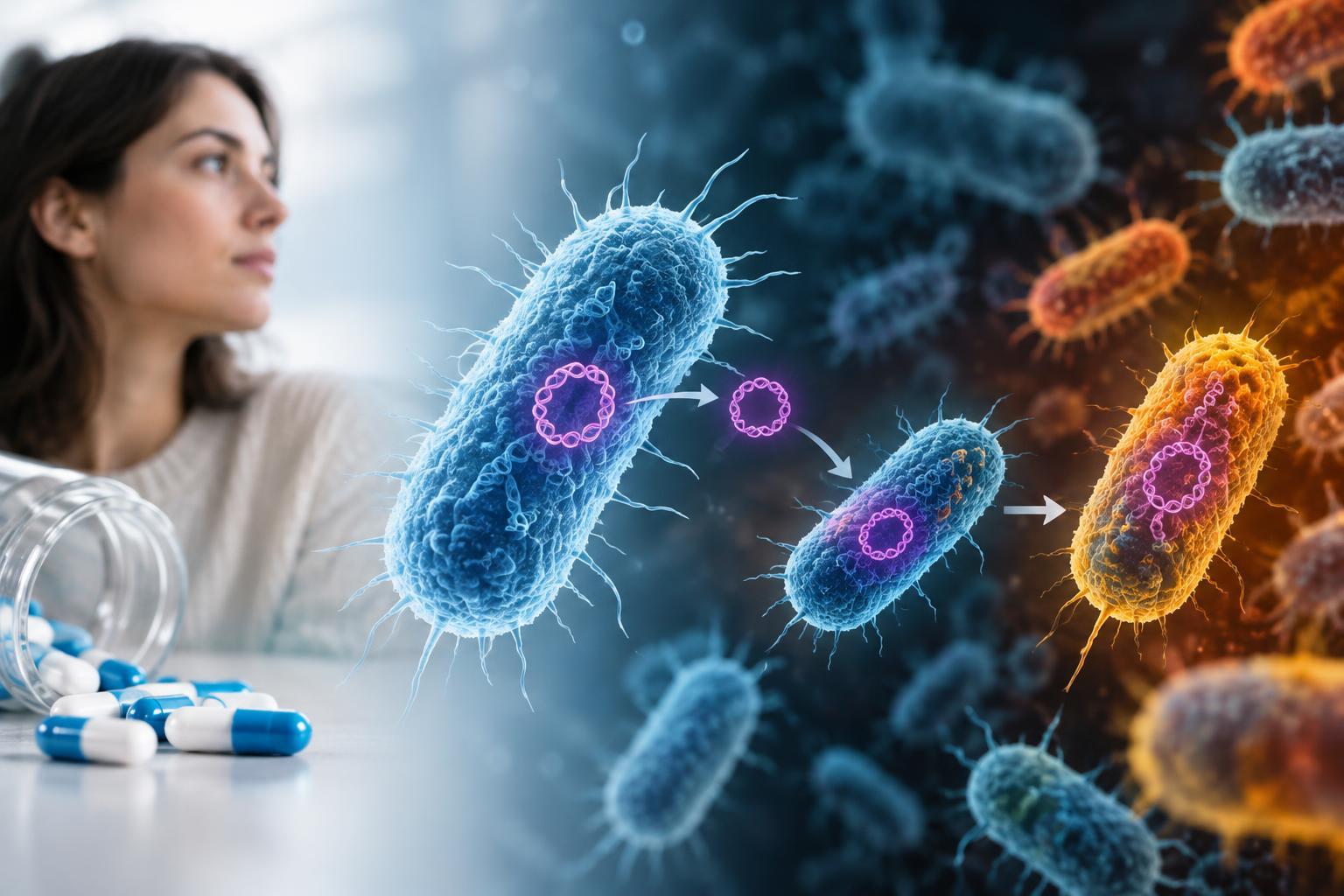
Resistance does not spread only from a bacterium to its descendants. Bacteria can also acquire DNA through horizontal gene transfer. One important route is conjugation, in which DNA passes between bacterial cells. Plasmids—DNA molecules separate from the main chromosome—can carry resistance genes, and some can move between different bacterial species.
Other routes include taking up DNA released into the environment and receiving DNA transported by viruses that infect bacteria. Not every transfer succeeds: incoming DNA must persist and function in its new host. Nevertheless, gene sharing allows an existing resistance mechanism to reach new bacterial populations without each population independently evolving it.
The genes involved provide several kinds of defense. Some encode enzymes that break down or chemically modify an antibiotic. Others produce pumps that expel the drug, change its target or help bacteria bypass the blocked process. A single bacterium may accumulate several mechanisms. When multiple resistance genes travel together, exposure to one antibiotic can help maintain a genetic package that also protects against other drugs.
Why resistance can persist and travel
Resistance sometimes carries a biological cost. Producing protective machinery or changing an essential cell process can make a bacterium less competitive when the antibiotic is absent. In those circumstances, susceptible bacteria may regain ground after selection pressure decreases. But removing exposure does not reliably erase resistance.
Some resistance traits have small costs, and additional mutations can reduce an initial disadvantage while preserving protection. Resistance genes may also remain linked to other beneficial traits. These possibilities explain why resistance can persist even when use of a particular antibiotic declines.
Resistant bacteria and resistance genes can move through connected human, animal and environmental settings. Transmission may involve contact, contaminated food or water, or environments where bacteria mix. Antibiotic exposure can also select resistant members of the normal microbiota, not just the bacteria causing an infection. Resistance is therefore both an evolutionary problem and a transmission problem: selection changes which bacteria thrive, while movement changes where they appear.
What this distinction means for controlling resistance
The phrase “my body is resistant” hides two important facts: resistance can arrive through transmission, and reducing unnecessary antibiotic exposure helps limit selection pressure. The broader response combines responsible antibiotic use with infection prevention, sanitation, vaccination where applicable, and monitoring of resistant organisms. These measures address different stages of the same process.
Laboratories can test whether a bacterial isolate is susceptible to particular antibiotics. However, an infection that is difficult to treat is not automatically evidence of resistance. Outcomes also depend on factors such as the infection site, drug delivery and the patient’s condition. Antibiotics do not treat viral infections, so a lack of benefit against a virus is not bacterial resistance.
The central lesson is simple: people do not become antibiotic-resistant; bacterial populations evolve and spread resistance. Keeping that distinction clear replaces a misleading idea about personal tolerance with a more useful picture of genetics, ecology and natural selection.


