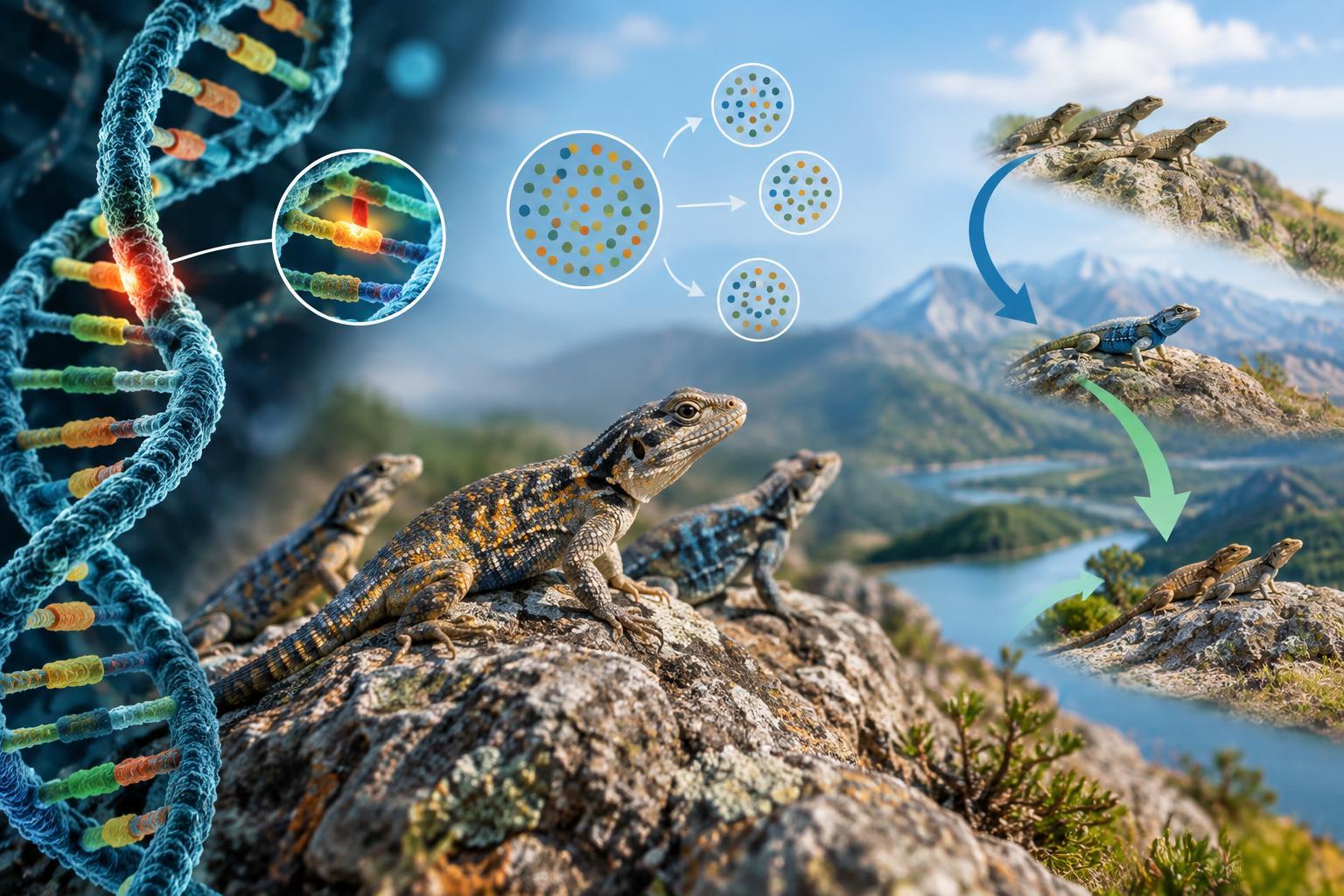
Evolution Is More Than Adaptation
Natural selection is a powerful explanation for how organisms become adapted to their environments, but it is not the whole story of evolution. In population genetics, evolution involves changes in the frequencies of genetic variants, called alleles, across generations. Those changes can happen because a variant improves reproductive success, but also because new variants arise, individuals move between populations, or chance affects which organisms reproduce.
The distinction matters because evolution is often mistaken for a steady march toward improvement. A population can evolve without becoming better suited to its surroundings. A neutral variant can become common, a useful variant can disappear, and migration can introduce traits that are less advantageous locally.
Mutation, genetic drift, gene flow, and natural selection usually operate together rather than in isolation. To understand an evolutionary outcome, the useful question is not simply whether a trait is beneficial. It is also where its genetic variation came from, how large the population is, and how connected it is to other populations.
Mutation Creates New Genetic Variation
A mutation is a change in genetic material. Mutations can arise through errors during DNA copying, damage to DNA, or other molecular processes. They range from changes in individual DNA building blocks to larger rearrangements or duplications. For a mutation to contribute directly to evolution across generations, it must be inherited. In many multicellular organisms, that generally means entering the lineage of cells that produces eggs or sperm.
Mutations are often described as random, but this needs qualification. Some DNA regions mutate more readily than others, and different conditions can influence mutation rates. The central point is that mutations do not generally occur because an organism needs a particular beneficial change. Their appearance is not a targeted response to a future survival problem.
The consequences depend on the mutation and its context. A variant may be harmful, beneficial, or have little detectable effect on reproductive success. Mutation supplies new variation, but natural selection often acts on variation already present in a population. Evolution does not need to wait for a fresh mutation every time conditions change.
Genetic Drift Changes Populations Through Chance
Genetic drift is the change in allele frequencies caused by chance in which genetic variants are passed to the next generation. Even if two variants confer identical reproductive prospects, their frequencies need not remain equal. By chance, some individuals leave more descendants than others. Over generations, an allele can disappear or become fixed, meaning it is the only allele remaining at that genetic location in the population.
Drift is generally stronger in small populations. Imagine a few seeds establishing plants on an isolated island. Their genetic makeup may not represent the source population accurately. This is a founder effect. A population bottleneck occurs when a sharp reduction in population size leaves fewer individuals contributing genes to later generations. Both situations can reduce genetic diversity through sampling effects.
Unlike natural selection, drift does not consistently favor variants that improve reproductive success. It can remove a beneficial allele while that allele is still rare, or increase a mildly harmful one. The outcome depends partly on the strength of selection relative to drift, not just on whether a variant is useful.
Gene Flow Connects Populations
Gene flow occurs when genetic material moves between populations and contributes to reproduction. Animals may migrate and breed in a new location, while plants can exchange genes through pollen or seeds. Movement alone is not enough: an individual that arrives but leaves no descendants does not contribute its alleles to the receiving population.
Gene flow can introduce alleles that were previously absent, increasing variation available to selection. It also tends to make connected populations more genetically similar. However, its effects are not always beneficial. Incoming alleles may support adaptation to changing conditions, or they may counter local adaptation if they are less suitable for the receiving environment.
Consider neighboring plant populations on dry and wet ground. Pollen exchange can move alleles between them, while selection favors different traits in each habitat. Whether the populations remain distinct depends partly on the balance between gene flow and local selection.
How the Mechanisms Work Together
Imagine an insect population colonizing a new habitat. The founders carry only part of the original population's variation. Drift changes allele frequencies as the small population grows. Mutations introduce additional variants, selection favors some inherited differences, and later arrivals bring alleles from elsewhere. The resulting population reflects all these processes, not one mechanism acting alone.
This combined perspective is useful in conservation, agriculture, and the study of disease-causing organisms. It helps explain why maintaining genetic diversity and population connections can matter, while also showing why context is essential. No single mechanism guarantees a particular outcome. Evolution is the changing inheritance of populations, shaped by both nonrandom reproductive differences and chance.