Energy and Entropy Answer Different Questions
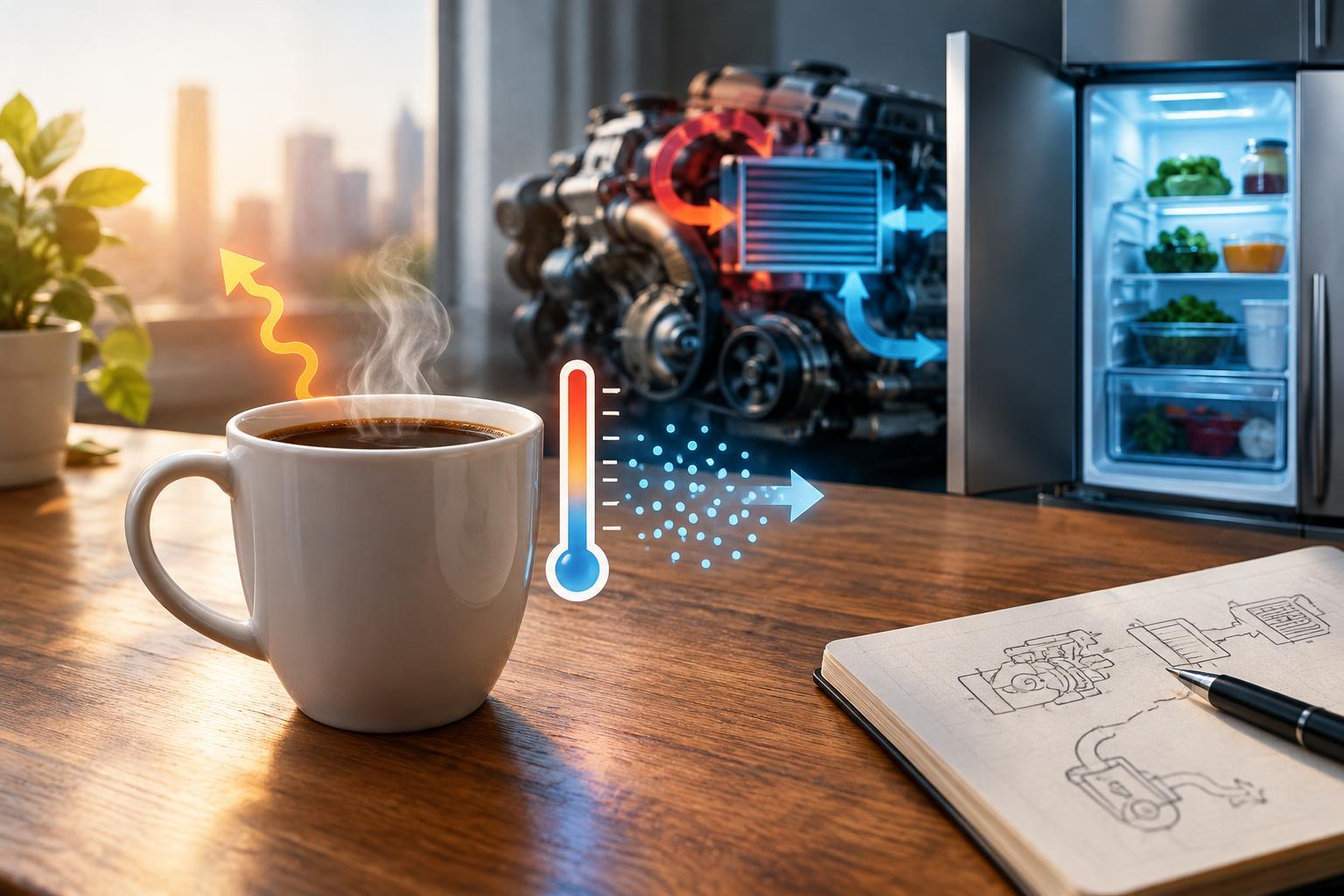
A hot cup of coffee cools on a desk, but a cool cup does not spontaneously draw warmth from the room and become hotter than its surroundings. Both scenarios could conserve energy. Why, then, does only one happen naturally? Energy conservation alone cannot explain the direction of a process. For that, we need entropy and the second law of thermodynamics.
Energy is a property that can be transferred between systems and converted between forms, including motion, chemical energy, and internal energy. Entropy is a different property: it describes how energy and matter are distributed among possible microscopic arrangements. It also helps determine which changes can occur spontaneously and how much useful work a process can deliver.
Before applying either law, define the system. A closed system exchanges energy but not matter with its surroundings. An open system exchanges both. An isolated system exchanges neither. These boundaries matter because a change inside one object may be balanced by a change outside it.
The First Law: Keeping the Energy Accounts Balanced
The first law states that energy is conserved. It cannot be created or destroyed, although it can move and change form. For a closed system whose overall motion and elevation do not change, the change in internal energy equals the heat added to it minus the work it does on its surroundings. Other situations also require accounting for changes in kinetic or gravitational potential energy.
Imagine gas inside a cylinder with a movable piston. Heating the gas can increase its internal energy, push the piston outward, or do both. The energy transferred as heat must be accounted for in those outcomes. Heat and work are methods of transferring energy, not substances stored inside the gas.
An electric kettle follows the same accounting. Electrical energy enters; much of it increases the internal energy of the water and kettle, while some reaches the surrounding air. Calling that energy “lost” is shorthand for saying it did not serve the intended purpose. It still exists elsewhere.
The Second Law: Why Natural Processes Have a Direction
The second law states that the total entropy of an isolated system cannot decrease. It increases during irreversible processes and remains constant in an ideal reversible process. Real processes involving friction, mixing, or heat transfer across a finite temperature difference generate entropy.
Return to the coffee. As energy passes from the hotter coffee to the cooler surroundings, the coffee loses entropy and the surroundings gain it. The surroundings gain more than the coffee loses, so the combined entropy increases. A local entropy decrease therefore does not violate the second law; the full accounting must include everything affected.
Entropy is often described as “disorder,” but that shortcut can mislead. A tidy-looking arrangement is not necessarily a low-entropy thermodynamic state. A more useful microscopic picture concerns the number of arrangements consistent with observable conditions. At everyday scales, spontaneous changes overwhelmingly favor macroscopic states compatible with more microscopic arrangements.
Why Conserved Energy Cannot Always Become Useful Work
If energy is never destroyed, why do machines need a continuing supply? Because energy quantity and usefulness are different. A temperature difference can drive a heat engine. Once the engine and its surroundings reach the same temperature, that particular opportunity disappears, even though the total energy remains.
A heat engine operating in a cycle takes heat from a hotter source, converts some into work, and releases the remainder to a colder destination. The second law prevents it from converting all the absorbed heat into work with no other effect. Even an ideal reversible engine has an efficiency limit determined by the temperatures of its hot and cold reservoirs, measured on an absolute scale.
Engineers use exergy to describe the maximum useful work available as a system comes into equilibrium with a specified environment. Unlike energy, exergy is destroyed by irreversibility. Friction illustrates the distinction: organized motion becomes internal energy, while the capacity to recover that energy as useful work is reduced.
Applying Both Laws to Everyday Technology
Refrigerators move heat from a colder interior to a warmer room by using external work, usually supplied electrically. Their operation lowers entropy locally, but the combined entropy of the appliance and surroundings increases. Heat pumps use the same principle to warm a building. They can deliver more heat than the electrical energy they consume because they move heat rather than create all of it from electricity.
Living organisms also maintain organized structures without breaking the second law. They exchange matter and energy with their surroundings, releasing heat and waste. Their internal organization does not make them isolated systems.
When evaluating an energy claim, ask two questions: Where does every energy transfer go, and what drives the proposed process? The first law checks the balance sheet. The second checks direction and limits. Together, they explain why better efficiency is possible, but unlimited useful work without an energy source is not.