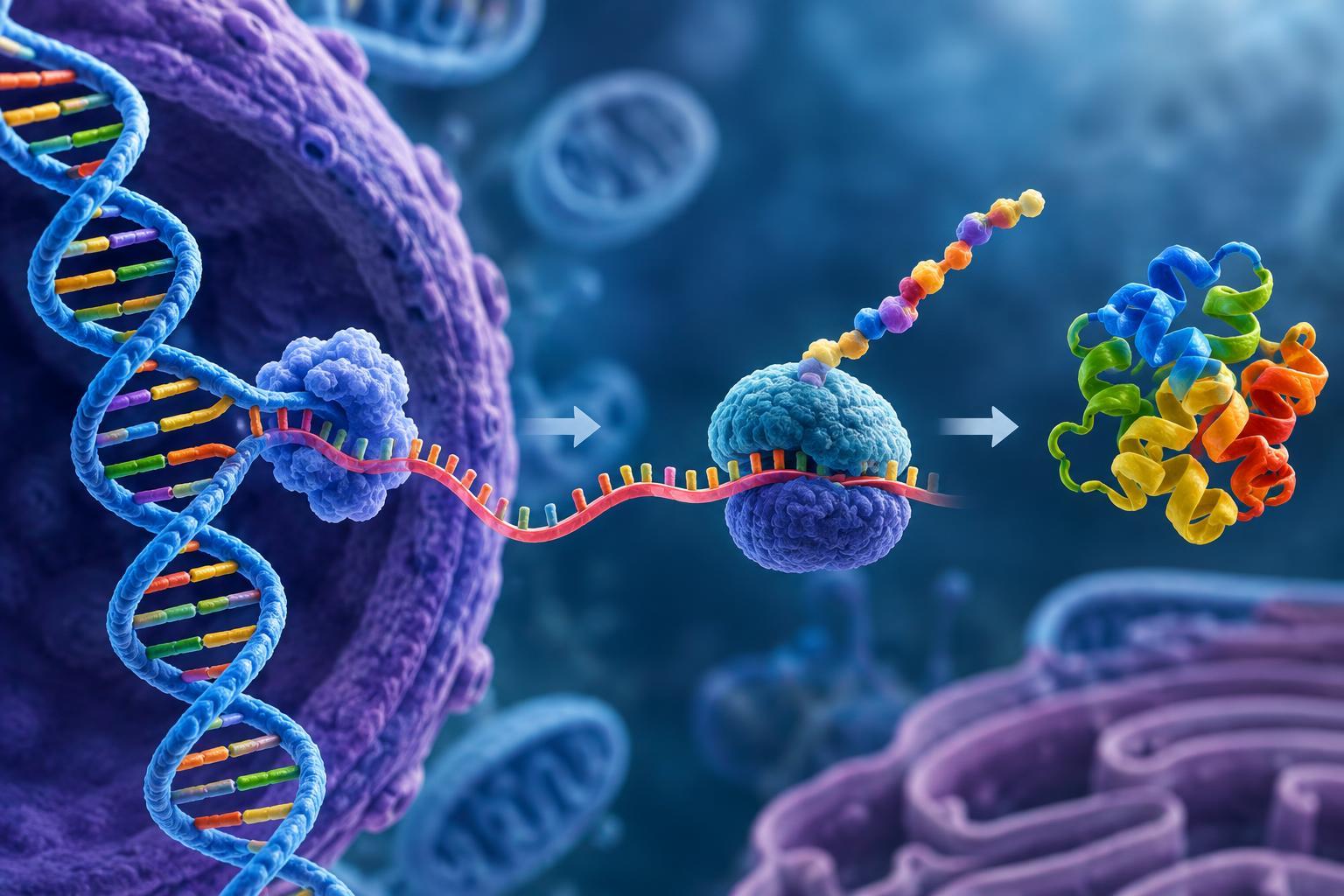
Genetic Information Is a Starting Point, Not a Finished Cell
A muscle cell contracts, a neuron transmits signals, and an immune cell responds to threats. Most cells in a person's body contain essentially the same DNA, yet they perform different tasks. Much of that diversity comes from gene expression: the processes through which information in a gene produces a functional RNA or protein. Cells differ not only in which genes they express, but also in when and how strongly they express them.
DNA stores information in sequences of four chemical bases, abbreviated A, T, C, and G. A gene is a stretch of DNA whose sequence contributes to a functional product. Some genes encode proteins; others produce RNA molecules that work without being translated. Nearby or distant regulatory DNA sequences help control when a gene is used.
For protein-coding genes, the basic information pathway is DNA to RNA to protein. This is the familiar outline associated with the central dogma of molecular biology. It is a useful framework, not a complete description of every biological pathway. For example, reverse transcription copies RNA into DNA, while many RNA molecules function directly rather than serving as protein templates.
Transcription: Making an RNA Copy
Gene expression begins with transcription. An enzyme called RNA polymerase uses one strand of DNA as a template to assemble an RNA molecule. RNA contains the bases A, U, C, and G, using uracil, or U, instead of DNA's thymine. The RNA sequence is complementary to the DNA template, allowing genetic information to be copied without consuming the original DNA.
Starting transcription requires more than finding a gene. RNA polymerase and associated proteins recognize control regions, including promoters. Regulatory proteins can help or hinder this process, making transcription an important point of control. A gene may therefore be present in the genome but produce little or no RNA in a particular cell.
In eukaryotic cells, such as animal and plant cells, transcription of nuclear genes occurs in the nucleus. Protein-coding transcripts usually undergo processing before they become mature messenger RNA, or mRNA. This commonly includes adding a protective cap, forming a poly(A) tail, and splicing out regions called introns. Alternative splicing can join the remaining regions in different combinations, allowing one gene to produce multiple RNA versions and potentially different proteins.
Translation: Reading RNA to Build a Protein
Once a mature mRNA reaches the cytoplasm, a ribosome can use it to build a chain of amino acids. This process is translation. The ribosome reads the mRNA in three-base units called codons. Most codons specify an amino acid, while others signal that translation should stop. A start codon, together with surrounding signals, helps establish where reading begins.
Transfer RNA, or tRNA, links the RNA code to amino acids. Each tRNA has a region that pairs with an appropriate mRNA codon and carries an amino acid attached by a specialized enzyme. The ribosome brings these components together and catalyzes the formation of bonds between amino acids. Ribosomal RNA is itself a central part of this machinery, illustrating that RNA can have structural and catalytic roles.
The immediate product is a polypeptide chain, not necessarily a ready-to-use protein. It must fold into an appropriate three-dimensional structure and may need chemical modifications, cleavage, or assembly with other chains. Some proteins also require transport to a particular cellular compartment. In bacteria, which lack a nucleus, translation can begin while an RNA is still being transcribed.
Protein Shape Connects Sequence to Cellular Work
An amino acid sequence influences how a protein folds and which molecules it can interact with. These properties enable proteins to perform many kinds of work. Enzymes accelerate chemical reactions, receptors detect signals, transport proteins move substances, and structural proteins help organize cells. The same information pathway can therefore produce tools for very different tasks.
Sequence alone does not fully determine a protein's activity inside a cell. Temperature, chemical conditions, interacting molecules, and modifications can affect its behavior. Cells use helper proteins called chaperones to assist folding and quality-control systems to manage damaged or incorrectly folded proteins. Controlled protein breakdown also helps adjust how much of a protein remains available.
Changes in DNA can alter a protein's sequence, affect how much product is made, or have little detectable effect. The outcome depends on the change and its biological context. This is why finding a sequence difference does not, by itself, establish a specific consequence for cell function.
Gene Regulation Makes Expression Responsive
Cells regulate gene expression at multiple stages. They can change how accessible DNA is, how rapidly RNA is transcribed, how transcripts are processed, and how long an mRNA survives. They can also control translation and the stability or activity of the resulting protein. Regulation is therefore a layered system rather than a single on-or-off switch.
These controls connect genetic information to changing needs. A cell receiving a signal may activate transcription factors, which alter the expression of selected genes. Regulatory RNAs can also influence expression, including by reducing the stability or translation of particular mRNAs. Such mechanisms support development, cell specialization, and responses to environmental conditions.
The practical lesson is that DNA sequence, RNA abundance, and protein activity describe different levels of biology. Detecting a gene does not show that it is active, and detecting its mRNA does not guarantee a matching amount of functional protein. Understanding cell function requires connecting these levels rather than treating any one of them as the whole story.