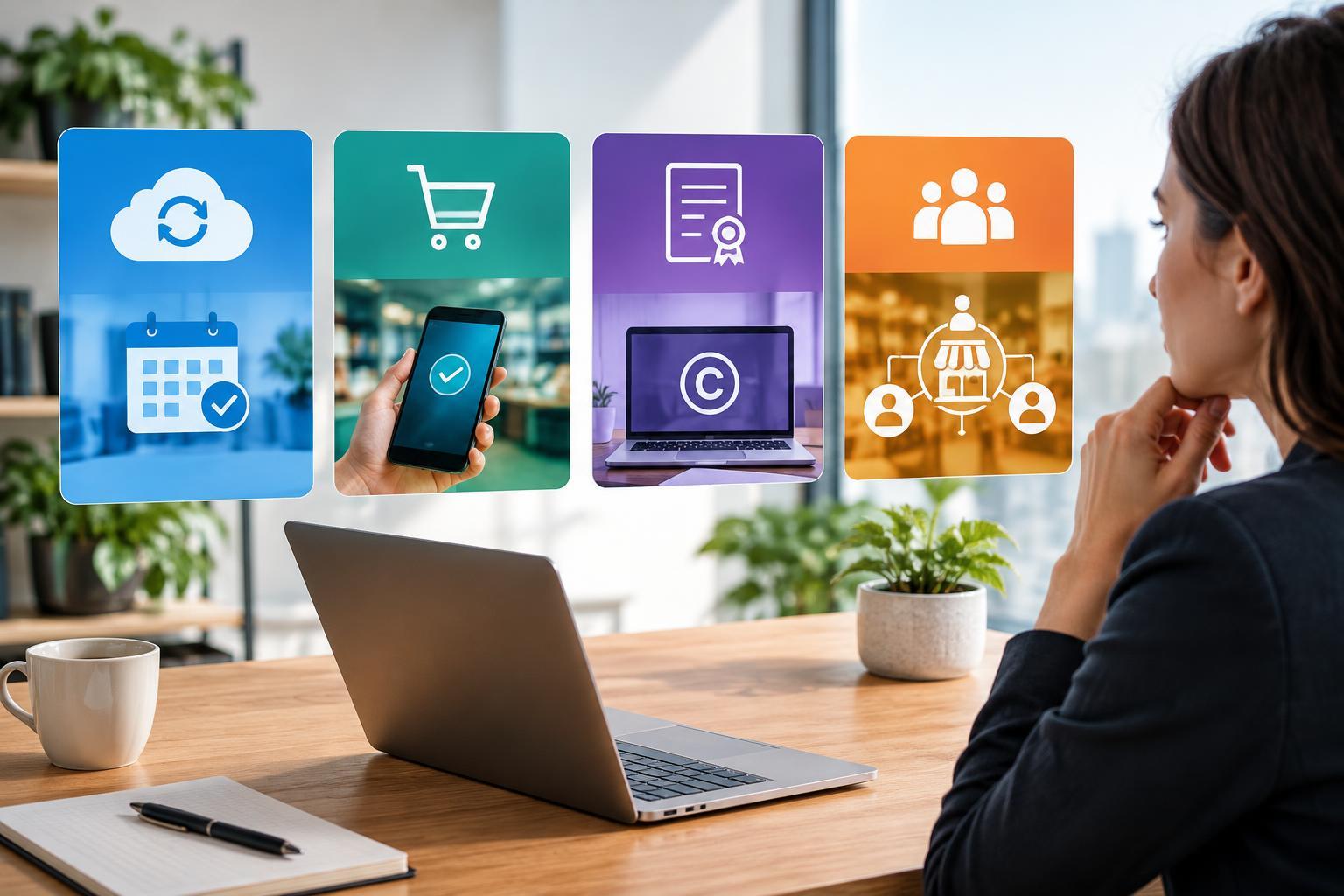
What a Business Model Actually Explains
A business model describes how a company creates value for customers and captures part of that value as revenue. It connects the offer, the paying customer, the delivery process, and the costs involved. A pricing plan is narrower: it specifies how much a customer pays and under what conditions. Two companies can use similar prices while operating very different businesses.
Consider a software tool. Its developer might charge monthly for access, collect a fee whenever it processes an order, or license the software to another company. Alternatively, it could operate a marketplace where independent developers sell related products. Each approach changes what generates revenue, which costs grow with demand, and what customers expect.
These models are not mutually exclusive. Subscription and transaction describe common charging structures, licensing centers on permission to use intellectual property, and a marketplace organizes exchanges between participants. Comparing them is useful, but understanding how they overlap is just as important.
Subscription: Customers Pay for Continued Value
A subscription business charges a recurring fee for ongoing access, service, or delivery. Examples include business software, membership communities, and regularly delivered household products. Revenue depends on the number of paying subscribers and their average subscription payment. Tiered plans can increase spending by offering more capacity, additional features, or broader access.
The appeal is a recurring customer relationship rather than the need to win every purchase again. However, recurring billing does not guarantee recurring satisfaction. Customers must keep receiving enough value to renew. A tool that becomes part of a daily workflow may support a subscription more naturally than a service someone needs only once.
Important measures include recurring revenue, cancellation rates, retention, and the cost of acquiring customers. Profitability also depends on delivery costs: a digital subscription may require substantial hosting and support, while a physical subscription adds sourcing and shipping. Annual prepayment can improve cash flow, but it also creates an obligation to deliver service throughout the paid period.
Transaction: Revenue Follows Each Purchase or Use
A transaction model earns revenue when a customer completes a purchase or performs a chargeable action. A retailer sells individual products, a consultant charges for a defined project, and a payment service collects a fee for processing a payment. Charges can be fixed, percentage-based, or linked to usage, such as the number of documents processed.
This model connects payment closely to an identifiable outcome. Customers can buy when needed without committing to an ongoing plan. The business, however, may face uneven demand and must encourage repeat purchases or continually attract new customers. Revenue can grow through more transactions, larger purchases, or higher fees, but each route has different implications for demand and cost.
Transaction value is not the same as profit. A retailer must account for product costs, fulfillment, returns, and other expenses. A processing service may incur infrastructure, support, and fraud-related costs. Useful measures include purchase frequency, average order value, and contribution margin: the revenue remaining after costs that vary with the sale.
Licensing: Revenue Comes from Permission to Use
Licensing allows another party to use intellectual property under agreed conditions while the owner retains ownership. The licensed asset might be software, a design, a brand, or a technical invention. Payment can take the form of an upfront fee, recurring fees, royalties tied to sales or usage, or a combination of these.
The economic attraction is that the same underlying asset may generate revenue from multiple licensees without the owner manufacturing or delivering every final product. That does not make licensing cost-free. Developing the asset, maintaining it, supporting licensees, and managing relationships can require substantial resources. Revenue may also become concentrated among a small number of important partners.
The details of permitted use shape the commercial offer. Scope, duration, exclusivity, user limits, and included support all affect value. Licensing can overlap with subscriptions when customers pay periodically for continued usage rights. A perpetual software license, by contrast, generally permits continued use of a specified version, while updates or support may carry separate charges.
Marketplace: Revenue Comes from Enabling Exchanges
A marketplace connects buyers and sellers rather than necessarily supplying the underlying product itself. It can earn commissions, listing fees, seller subscriptions, advertising revenue, or fees for services such as fulfillment. Total sales facilitated through the platform should not be confused with the platform's own revenue: the marketplace may retain only a portion of each sale.
Its central challenge is making participation worthwhile for both sides. Buyers need relevant supply and a dependable purchasing experience; sellers need access to suitable demand. More participants can improve the service, but scale alone is insufficient. Search quality, trust, dispute handling, and the ability to complete a suitable transaction all influence whether people return.
Choosing among these models starts with customer behavior and delivery economics. Repeated needs may suit subscriptions, occasional needs may favor transactions, reusable intellectual property may support licensing, and fragmented supply and demand may create a marketplace opportunity. Hybrid models can work well, provided each charge has a clear purpose and the combined offering remains understandable to customers.