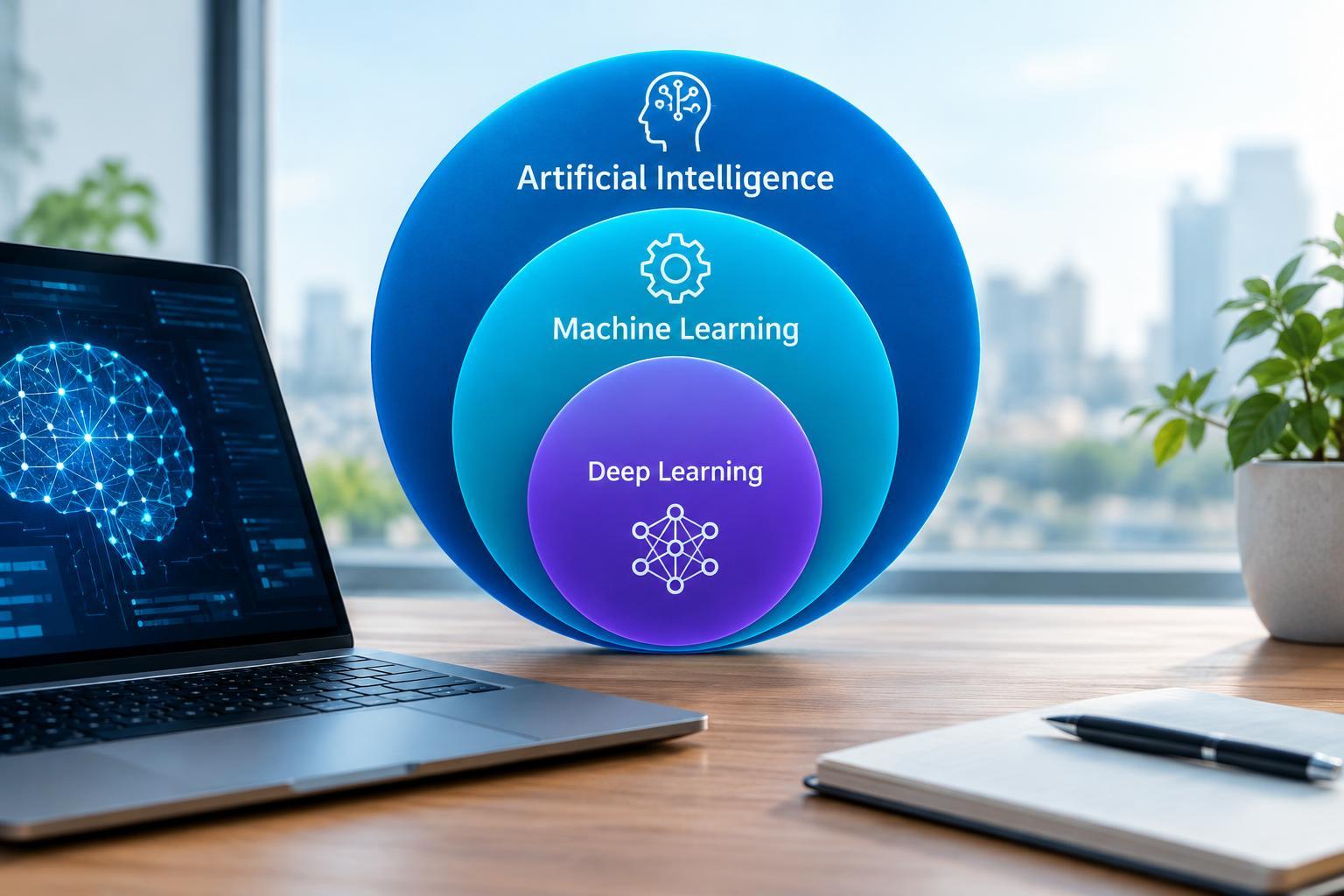
The Big Picture: Three Nested Concepts
Artificial intelligence, machine learning, and deep learning describe different levels of the same broad field. Artificial intelligence is the umbrella term. Machine learning is a major approach within AI, and deep learning is a specialized form of machine learning. Every deep learning system uses machine learning, but not every machine learning system uses deep learning.
The difference is easiest to understand by asking three questions. AI asks how computers can perform tasks associated with intelligence. Machine learning asks how computers can learn useful patterns from data rather than relying entirely on explicitly written rules. Deep learning asks how neural networks with multiple processing layers can learn complex representations of that data.
These labels describe approaches, not guarantees of quality. A deep learning model is not automatically more accurate, useful, or intelligent than a simpler system. Its value depends on the task, the available data, and the conditions in which it operates.
Artificial Intelligence: The Broad Goal
Artificial intelligence covers systems designed to perform tasks such as reasoning, planning, understanding language, recognizing objects, and making decisions. It includes both systems that learn from data and systems that follow human-defined knowledge or rules. AI is therefore broader than the predictive models and chatbots that often dominate discussions.
A rule-based expert system illustrates AI without machine learning. For example, a troubleshooting tool might use a structured collection of rules to suggest why a machine has stopped working. Its recommendations come from encoded knowledge, not patterns learned during training. Search and planning algorithms offer other examples, such as exploring possible moves in a game.
The boundary between AI and ordinary software is not perfectly fixed. Not every automated process is meaningfully described as AI. A script that copies files on a schedule is automation, while a system that reasons through competing plans falls more clearly within AI. In practice, the underlying method matters more than the label.
Machine Learning: Learning Patterns from Data
Machine learning replaces some hand-written decision logic with a model trained on examples or experience. During training, an algorithm adjusts the model to improve performance according to an objective. Once trained, the model can process new inputs, such as estimating delivery times or identifying messages that resemble known spam.
Common approaches include supervised learning, which uses examples paired with target answers; unsupervised learning, which looks for structure without those target answers; and reinforcement learning, which learns behavior through rewards and interaction. Methods range from linear models and decision trees to neural networks. Deep learning belongs within this collection rather than competing with it as a separate field.
In many conventional machine learning workflows, people define useful input features. A delivery-time model might use distance, package size, and service type. Data quality and evaluation are crucial: a model can appear successful during development yet fail on new cases if the training examples are unrepresentative or accidentally contain information unavailable when predictions are made.
Deep Learning: Learning Layered Representations
Deep learning uses neural networks with multiple layers to transform inputs into increasingly useful internal representations. For image recognition, early processing may capture simple visual patterns, while later processing combines information into more complex structures. These representations are learned through optimization rather than being entirely specified by a developer.
This ability makes deep learning particularly useful for complex inputs such as images, audio, and language. Many speech recognition systems, image generators, and large language models use deep learning. Generative AI describes what a system does—producing content—rather than a separate level in the AI hierarchy. Many prominent generative systems are deep learning models.
Training large deep learning models from scratch can require substantial data and computing resources. However, using an existing pretrained model can reduce those requirements for a particular project. Deep learning still needs careful data preparation and evaluation, and its internal decisions can be difficult to explain. Fluent text or convincing images do not establish factual accuracy or reliable reasoning.
How to Choose the Right Approach
Start with the problem rather than the technology. If the requirements are stable and can be expressed clearly, explicit rules may be sufficient. If examples reveal patterns that are difficult to capture manually, machine learning may help. For complex language, audio, or image tasks, a pretrained deep learning model is often worth evaluating.
For structured business data, such as spreadsheet-like records, simpler models and tree-based methods can be strong candidates. Compare approaches using representative test data and criteria that reflect actual use: accuracy, error costs, speed, operating expense, explainability, and maintenance. A more complex model should earn its place by delivering a meaningful benefit.
Real systems often combine all three levels. A support application might use rules to enforce access permissions, a conventional machine learning model to route requests, and a deep learning model to draft responses. The essential distinction remains simple: AI is the broad field, machine learning learns from data, and deep learning does so with multilayer neural networks.